Condo Insurance Coverage Types: A Clear Overview

Condo ownership comes with unique insurance needs that differ from traditional homeowner policies. Your condo association’s master policy covers the building structure, but it leaves gaps that your personal HO-6 policy must fill.
At Direct Insurance Services, we’ve helped countless condo owners understand exactly which condo insurance coverage types protect their investment and which ones they’re responsible for. This guide breaks down what you actually need to know.
HO-6 Condo Owner’s Insurance Coverage
HO-6 insurance is your personal safety net for everything inside your condo unit that the association’s master policy doesn’t cover. This policy protects the interior structure of your unit-from drywall inward-along with your personal belongings, liability exposure, and temporary housing costs if a covered event displaces you. The interior structure coverage pays to repair or replace flooring, cabinets, built-in appliances, and fixtures damaged by fire, wind, hail, or the weight of ice and snow. Personal property coverage reimburses you for belongings like furniture, electronics, and clothing damaged or stolen due to covered perils, typically up to your policy limits. Liability coverage protects you financially if someone is injured in your unit or if you accidentally damage a neighbor’s property-a real concern in condo living where shared walls and common areas create more frequent accident opportunities than single-family homes. Medical payments coverage under your HO-6 pays for minor injuries to guests in your unit, regardless of fault, which often prevents small incidents from becoming lawsuits.
Understanding Your Interior Walls-In Coverage
The walls-in boundary matters because it defines your responsibility versus the association’s. If your HOA master policy is bare walls-in, your HO-6 must cover everything from the interior drywall outward, including flooring, paint, fixtures, and any built-in appliances. If your master policy is all-inclusive, your HO-6 may cover less of the interior since the association already handles original fixtures and some interior elements. Request your HOA’s master policy language from management and review it alongside your HO-6 quote to confirm you’re not duplicating coverage or leaving gaps. Dwelling coverage limits should reflect current rebuild costs for your specific unit, not the purchase price-a 1,200-square-foot condo in Utah averages $150–$200 per square foot to rebuild, meaning you’d need roughly $180,000–$240,000 in dwelling coverage, though your association may set specific minimum requirements.
Personal Property Coverage That Matches Your Belongings
Personal property coverage protects your belongings whether they’re inside your unit or temporarily outside it. Create a detailed home inventory that documents furniture, electronics, jewelry, and appliances with photos or receipts-most people underestimate their belongings’ replacement cost and end up under-insured. If your inventory totals $85,000 in belongings, you need at least $85,000 in personal property coverage; replacement cost coverage is strongly preferable over actual cash value because it pays what items cost today, not what they cost when you bought them years ago.
Liability and Loss of Use Limits
Liability coverage typically ranges from $100,000 to $500,000, with $300,000 being a solid middle ground for most condo owners, though consider higher limits if you frequently host guests or have activities that increase injury risk. Loss of use coverage reimburses hotel stays, meals, and other temporary living expenses if a covered event makes your unit uninhabitable-try setting this at around 20% of your combined dwelling and personal property limits, so if you carry $200,000 in combined coverage, try for $40,000 in loss of use protection. These coverage decisions directly affect what gaps your additional policies must fill, which we’ll explore in the next section.
Additional Coverage Options for Condo Owners
Your HO-6 policy handles the core protections, but standard coverage stops short in three critical areas where condo owners face real financial exposure. These gaps cause problems for owners who assume their basic HO-6 is enough. Loss assessment coverage protects you when the HOA master policy hits its limit and the association assesses unit owners for the shortfall-without this endorsement, you could owe thousands out of pocket if a major building failure occurs.
Loss Assessment Coverage Protects Against Special Assessments
A $50,000 roof replacement that exceeds the master policy’s coverage could result in a $5,000–$10,000 assessment per unit depending on your building’s size, and standard HO-6 policies don’t cover this cost. Start with a $1,000 loss assessment limit as a baseline, though owners in older buildings or those with aging systems should consider $5,000 or higher. This endorsement activates only when the association levies a special assessment, making it an affordable way to protect yourself from unexpected bills that can strain your finances.
Improvement and Alteration Coverage Fills a Major Gap
Many owners assume the master policy covers their renovations-it doesn’t. If you upgraded your kitchen cabinets, installed new flooring, or added custom fixtures, the bare walls-in or single entity master policies exclude these improvements entirely. Your HO-6 dwelling coverage typically includes improvements you’ve made, but limits vary by insurer and may not fully cover high-end renovations. Document all improvements with receipts and photos, then verify your HO-6 limit actually covers the replacement cost of what you’ve installed, not just the original unit condition. This step prevents you from discovering mid-claim that your $30,000 kitchen renovation falls outside your policy’s dwelling limit.
Water Damage and Flood Insurance: The Largest Coverage Gap
Water damage and flood insurance represent the largest coverage gap in condo ownership because standard HO-6 policies exclude both. Sudden internal plumbing leaks are covered, but water backing up through drains, seeping from underground sources, or flooding from external water is not-you need a water backup and sump overflow endorsement to cover sewer and drain backup, which typically costs $25–$75 annually and adds $5,000–$25,000 in protection. Flood insurance is separate entirely and requires a standalone policy through the National Flood Insurance Program or private carriers, costing $400–$1,200 per year depending on your flood zone and coverage limits.
Many condo owners skip flood insurance because their unit is on the third floor, but water damage claims from building flooding or heavy rain affecting lower levels are common in Utah during spring runoff and monsoon seasons, making this coverage practical rather than theoretical. Before finalizing any HO-6 quote, confirm with your agent which endorsements are included, which ones you need to add separately, and what dollar limits apply to water damage scenarios specific to your building’s location and construction. Understanding these three coverage areas positions you to evaluate what your association’s master policy actually covers and what your personal policies must address.
What Your Condo Association’s Master Policy Covers
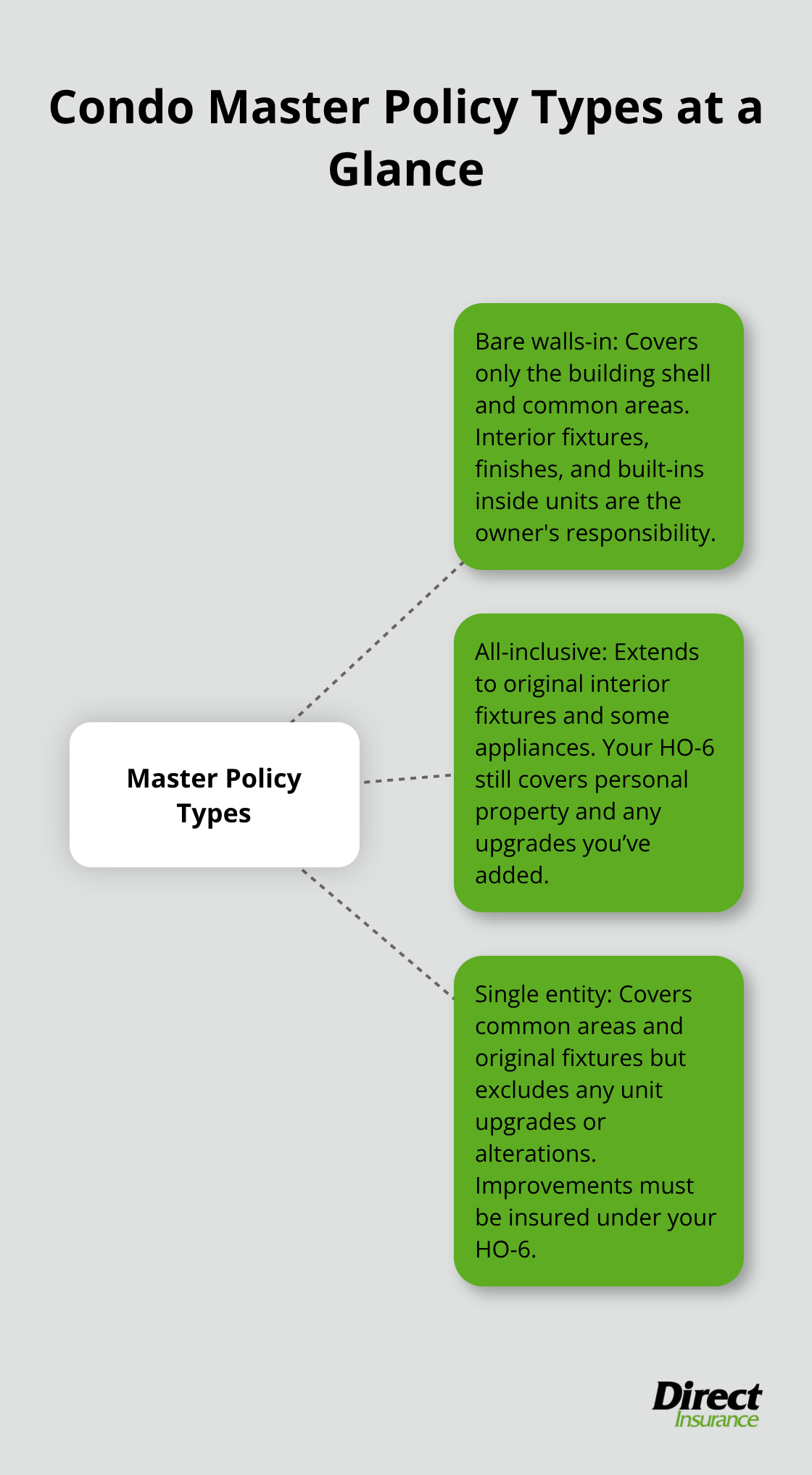
Your HOA’s master policy forms the foundation of your building’s insurance, but most condo owners misunderstand what it protects. The master policy covers the building structure itself-the roof, exterior walls, foundation, and the framing that holds everything together. It also covers shared spaces like hallways, stairwells, lobbies, fitness centers, pools, and parking areas. The scope depends on your building’s master policy type: bare walls-in policies cover only the building shell and common areas, leaving interior unit elements to you; all-inclusive policies extend further to cover original interior fixtures and some appliances, reducing your personal coverage burden; single entity policies cover common areas and original fixtures but exclude any upgrades or alterations you’ve made.
How Master Policy Deductibles Work
When the association’s master policy covers something and a covered peril damages it, the association files the claim, and you typically pay only the master policy’s deductible-often $5,000 to $25,000 depending on the building-rather than your individual HO-6 deductible. This structure means a roof leak that damages your interior drywall, flooring, and belongings splits the financial responsibility: the master policy covers the roof repair while your HO-6 covers everything inside your unit, but only if you have adequate dwelling and personal property limits. Shared amenity liability is also handled by the master policy, meaning if a guest slips on the pool deck or is injured in a common area, the association’s liability coverage addresses it, not your personal HO-6.
Identifying Coverage Gaps That Affect You
The critical mistake condo owners make is assuming the master policy covers everything, then discovering mid-claim that their personal improvements, interior damage, or belongings fall outside its scope entirely. Request the actual master policy document from your HOA management, not just a summary-read the specific coverage limits, exclusions, and deductible amounts. If the building experiences water damage affecting multiple units beyond the master policy’s limit, the association can assess unit owners for the shortfall-this is where loss assessment coverage on your HO-6 becomes essential.
Water and Flood Exposure in Your Building
Many owners discover too late that their master policy excludes flood coverage entirely, leaving them exposed during heavy rain or spring runoff events common in Utah. The master policy also won’t cover your personal renovations, your electronics, or your liability if you cause damage outside your unit boundaries. Water damage claims from building flooding or heavy rain affecting lower levels are common in Utah during spring runoff and monsoon seasons, making this coverage practical rather than theoretical for most condo owners.
Coordinating Your HO-6 With Master Policy Coverage
Schedule a consultation with an insurance agent specifically to review your HOA’s master policy language alongside your HO-6 quote, confirming which coverages overlap, which gaps exist, and what dollar limits you actually need for your situation rather than relying on general assumptions about what the association handles. This step prevents you from discovering mid-claim that your personal improvements or belongings fall outside your policy’s limits.
Final Thoughts
Condo insurance coverage types work together to protect what matters most: your unit, your belongings, and your financial security. Your HO-6 policy handles your interior space and personal property while the master policy covers the building shell and common areas, but the gaps between them create real financial exposure. Most condo owners carry inadequate dwelling limits, skip loss assessment coverage, and ignore water damage endorsements until a claim forces them to confront what they’re actually protected for.
Start by requesting your HOA’s actual master policy document from management and reviewing it with an insurance professional who understands condo-specific risks. Document your belongings and renovations with photos and receipts so you know exactly what replacement cost coverage you need. Confirm your dwelling limit reflects current rebuild costs for your unit, not the purchase price you paid years ago, and add loss assessment coverage at minimum.
We at Direct Insurance Services work with condo owners throughout Utah to align their HO-6 policies with their association’s master policy, identifying gaps and tailoring coverage to your actual situation rather than generic assumptions. Contact us to review your current coverage or get a quote that accounts for your building’s master policy type and your personal circumstances.
Disclaimer: The information provided in this blog is for general informational purposes only and does not constitute legal, financial, or insurance advice. Coverage options, terms, and availability may vary. Please consult with a licensed professional for advice specific to your situation


