Auto Insurance for Teens: Finding Affordable, Safe Coverage

Teen drivers face insurance premiums that are significantly higher than adult drivers. At Direct Insurance Services, we know that parents and teens need practical strategies to find affordable auto insurance for teens without sacrificing protection.
This guide walks you through why rates are steep, which discounts actually work, and how to pick coverage that fits your budget and keeps your family safe.
Why Teen Drivers Cost More to Insure
Teen drivers represent a measurable risk that insurers cannot ignore. The statistics are stark: drivers aged 16 to 19 have a fatal crash rate almost three times as high as drivers ages 20 and older per mile driven, according to data from the CDC. When a crash happens, teen drivers are more likely to suffer serious injury or death. This isn’t opinion-it’s the foundation of how insurance companies calculate premiums. Insurers use decades of accident data to determine that a 16-year-old behind the wheel costs them significantly more in claims than a 40-year-old.
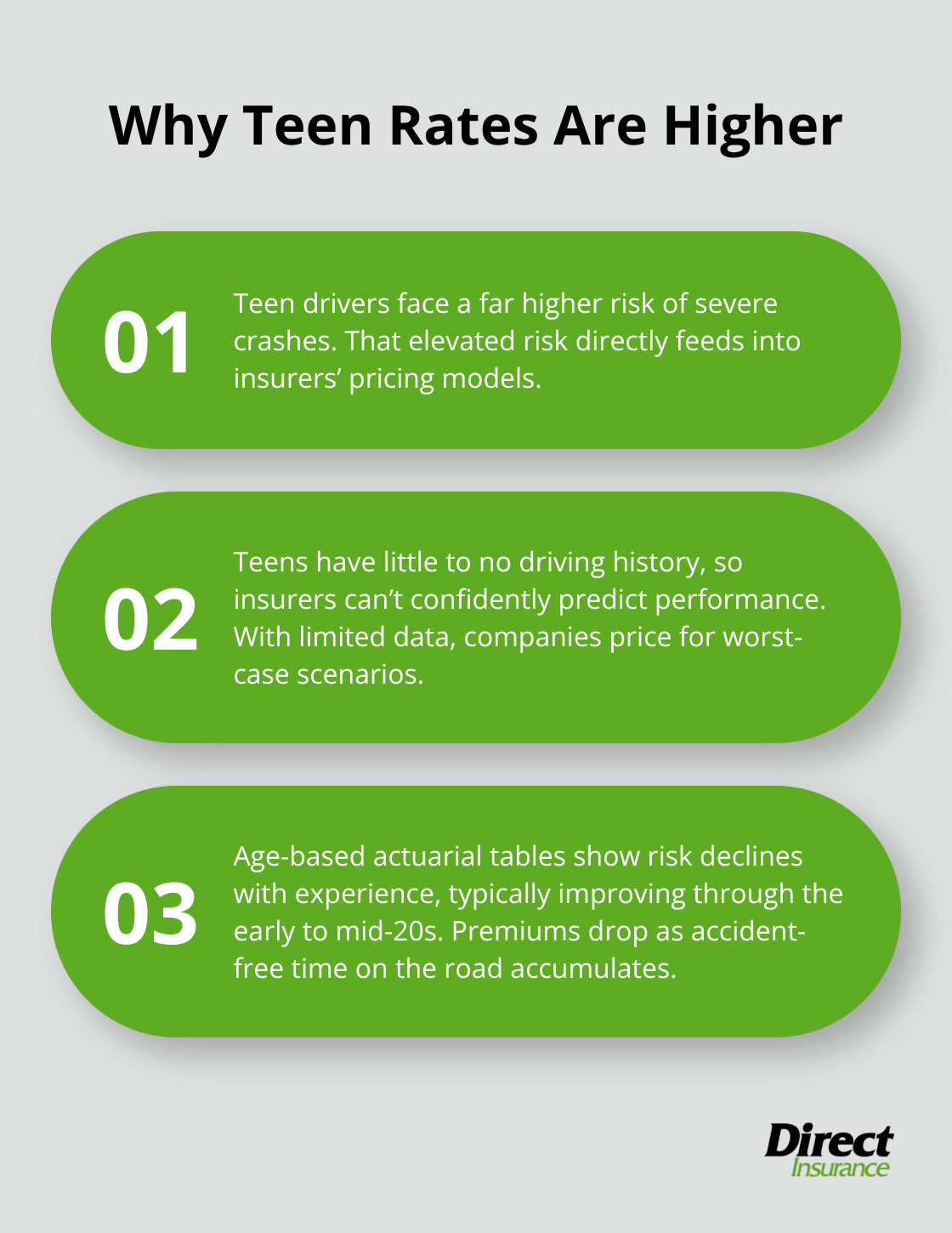
Age alone matters because it correlates directly with crash risk. A teen’s brain is still developing the judgment and impulse control that safe driving requires. They take more risks, react more slowly to hazards, and underestimate dangerous situations. Insurance companies price accordingly because they know the statistical reality: younger drivers file more claims, and those claims tend to be larger.
Experience Gaps That Show Up in Premiums
Experience matters enormously, and teens have none. An adult driver with 20 years of clean driving history has proven they can handle unexpected road situations. A 16-year-old with a learner’s permit has not. Insurance companies weight this heavily-they cannot predict how a teen will perform once they’re driving independently. Limited track records mean insurers must assume worst-case scenarios and price accordingly. A 25-year-old driver with five years of clean driving receives better rates than a 17-year-old, even if both have accident-free records, because time on the road builds credibility. The longer a driver goes without an accident, the more confident insurers become. Teens simply haven’t had enough time to build that confidence, so they pay more.
How Age-Based Calculations Actually Work
Insurance companies don’t charge teen rates arbitrarily-they use actuarial tables built from millions of claims. These tables show that a 16-year-old pays roughly double what a 25-year-old pays for identical coverage. The decline happens gradually. Premiums drop year after year as teens age, especially if they maintain a clean driving record, often continuing until around age 25 when the brain’s risk-assessment regions fully mature. This is why a teen turning 18 might see a modest rate decrease, but the biggest drops happen between ages 19 and 25. Some states have different calculations, and some insurers adjust rates differently, but the pattern remains consistent: youth equals higher cost. The good news is this situation improves predictably. A teen who avoids accidents will see their rates decline noticeably each year, making insurance more affordable as they age and build their record.
What This Means for Your Family’s Budget
Understanding why teen insurance costs more helps you prepare financially and make smarter decisions. You can’t eliminate the age factor, but you can control other variables that insurers consider (vehicle choice, coverage levels, and available discounts). The next section shows you exactly which discounts work and how to lower your teen’s premiums without leaving your family underprotected.
How to Actually Cut Teen Insurance Costs
The age factor is locked in, but nearly everything else about your teen’s insurance is negotiable. The difference comes down to three concrete actions: qualifying for the discounts that actually exist, choosing the right vehicle, and bundling intelligently.
Good Student Discounts Reward Academic Performance
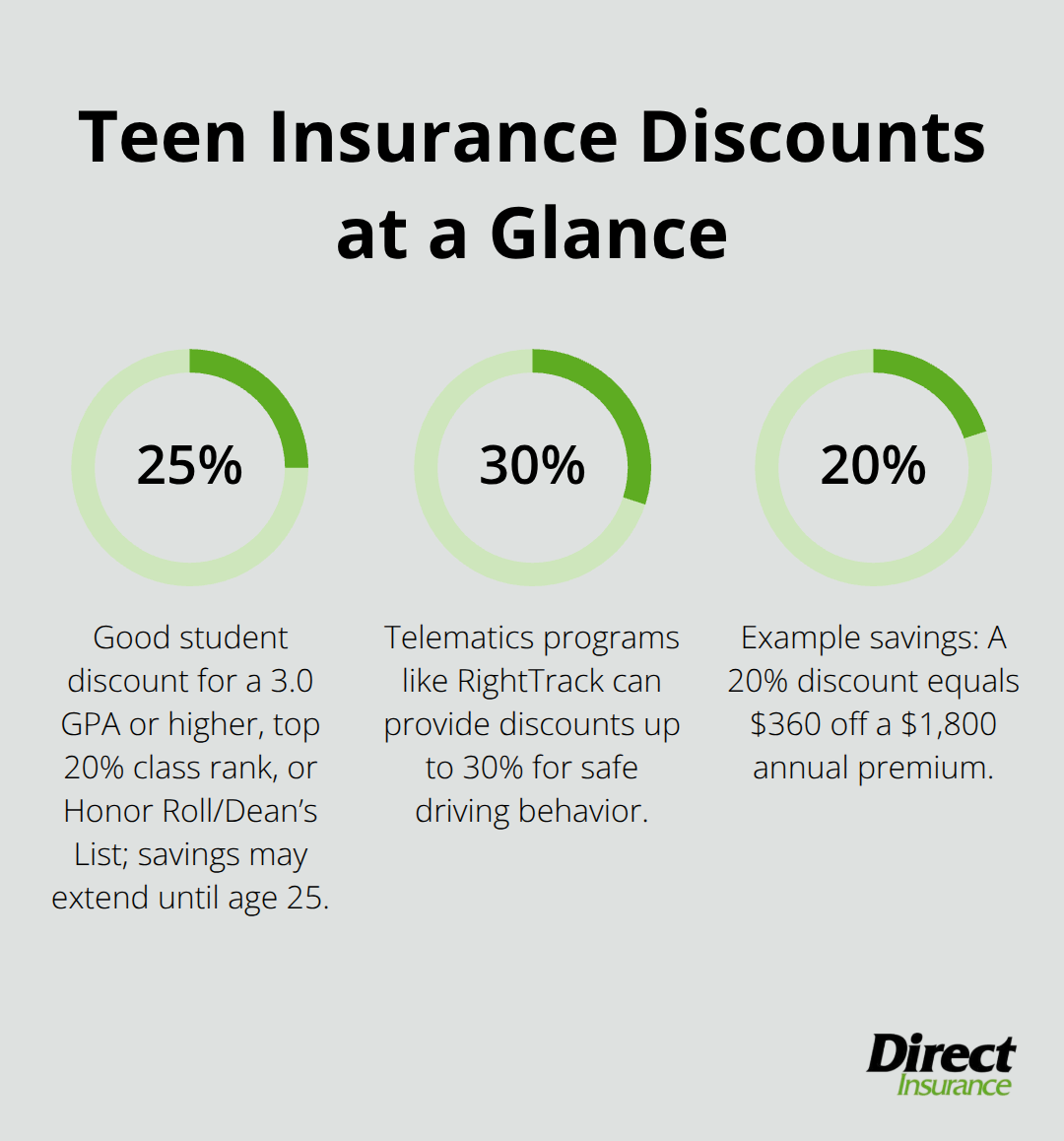
Start with the good student discount, which delivers real money. State Farm offers up to 25% savings for teen drivers with a 3.0 GPA or higher, ranking in the top 20% of their class, or making the Dean’s List or Honor Roll, with savings extending until age 25. If your teen’s base premium runs $1,800 annually, a 25% reduction saves $450 per year. The catch is simple: your insurance company needs proof. Request official transcripts from your teen’s school and submit them to your agent before the policy starts. Update the discount if your teen’s grades improve mid-policy. Many families leave this money on the table because they assume their insurer will automatically know their teen’s academic standing. They won’t. You must tell them and provide documentation.
Defensive Driving Programs and Telematics Monitoring
Defensive driving courses deliver measurable value beyond the classroom. A teen who completes an approved driver education course qualifies for a driver training discount, and some states offer additional savings through programs like Steer Clear or Drive Safe & Save. These programs monitor actual driving behavior through a mobile app or a small device plugged into your vehicle’s diagnostic port, rewarding safe habits with discounts up to 30% for users of telematics programs like RightTrack. If your teen drives safely and earns a 20% discount through a monitoring program, that’s $360 off a $1,800 premium. Your teen’s driving score improves as they practice, and their confidence grows alongside the proof of their safe habits.
Vehicle Selection Impacts Insurance Costs Significantly
Vehicle selection matters more than most parents realize. A 2020 Honda Civic costs far less to insure than a 2020 Dodge Charger because repair costs and safety ratings differ dramatically. Insurance companies know that a Civic’s parts are cheaper and its safety features stronger. When shopping for your teen’s first car, try vehicles with high safety ratings from the National Highway Traffic Safety Administration, proven reliability records, and reasonable repair costs. A $12,000 used Honda Accord might have a lower insurance premium than a $10,000 used sports coupe.
Bundle Policies for Maximum Savings
Finally, bundle your auto and home policies. Customers who bundle auto and home insurance save over $950 annually according to industry data, with potential additional savings when adding other products like umbrella coverage. If you’re not bundling yet, contact your agent immediately. This single move often outpaces any individual discount in raw dollars saved. Once you’ve locked in these savings, the next step involves selecting the right coverage levels for your teen’s specific situation and driving patterns.
What Coverage Do Teen Drivers Actually Need
Utah’s Liability Requirements and Why Minimums Fall Short
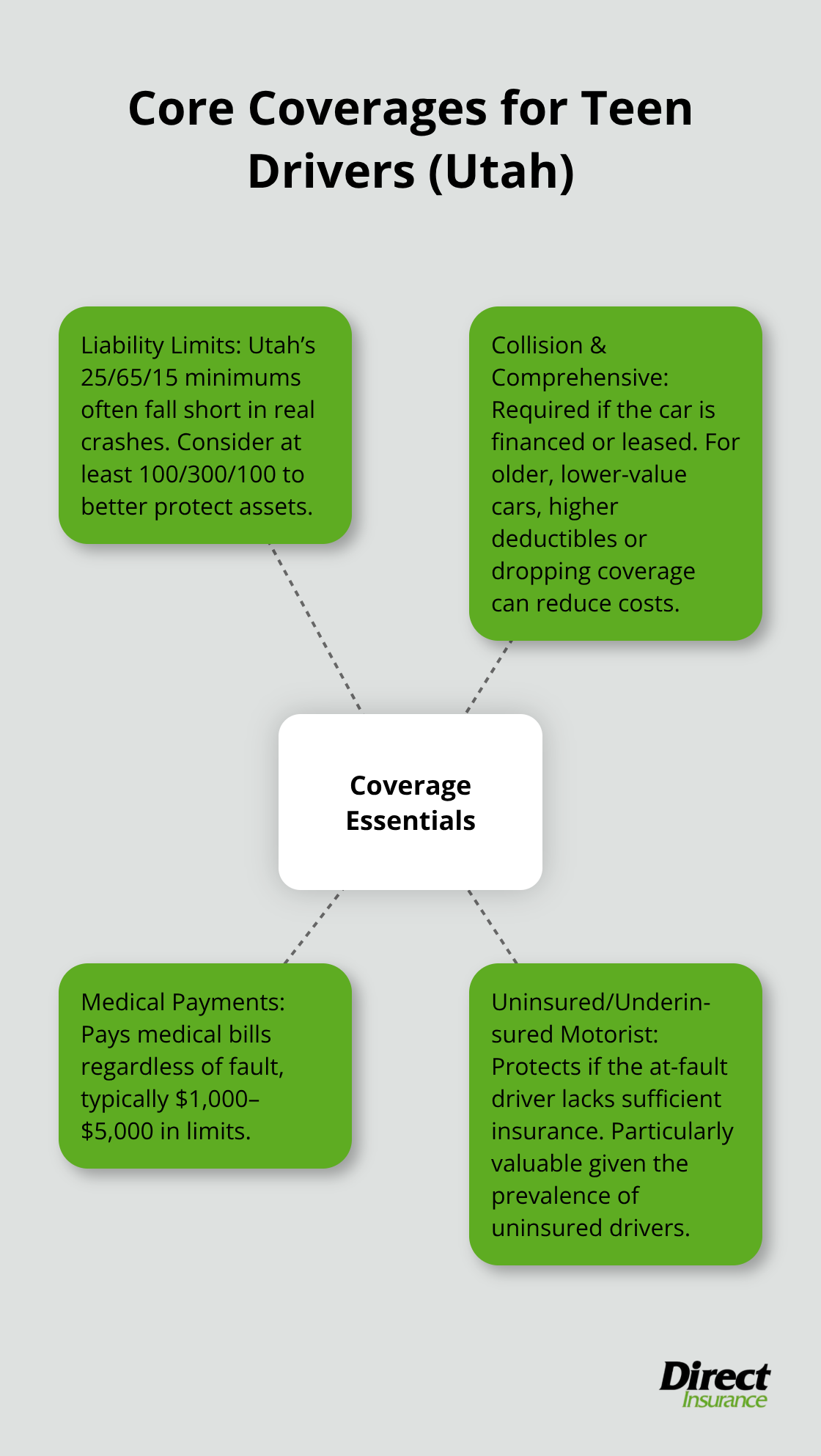
Utah requires every driver to carry liability insurance with minimum limits of 25/65/15, meaning $25,000 for bodily injury per person, $65,000 for bodily injury per accident, and $15,000 for property damage. These minimums exist because they cover the legal threshold, but they fall short in real-world accidents. A single serious injury can rack up $100,000 in medical bills alone, leaving your family exposed if you stick with state minimums. Higher limits cost only slightly more than minimums but protect your assets far better. If your teen causes an accident that injures two people with $60,000 in medical costs each, the 25/65/15 minimum leaves you personally liable for $55,000 after insurance pays out. We recommend carrying at least 100/300/100 coverage to eliminate that gap.
Collision, Comprehensive, and Medical Payments Coverage
Collision coverage protects your teen’s vehicle when they hit another car or object, while comprehensive coverage handles theft, weather, vandalism, and animal strikes. If your teen’s car is financed or leased, your lender requires both. If you own the vehicle outright, collision and comprehensive become optional, but dropping them on a $15,000 car makes sense only if you can absorb a total loss. For a $5,000 used car, skipping these coverages or raising your deductible to $1,000 saves real money monthly without creating catastrophic risk.
Medical payments coverage pays your teen’s medical bills regardless of fault, up to your chosen limit, typically $1,000 to $5,000. Uninsured and underinsured motorist coverage protects your teen if hit by a driver with insufficient insurance or no insurance at all, covering injuries and vehicle damage.
In 2022, 14.0 percent of motorists, or about one in seven drivers, were uninsured, making this coverage genuinely valuable.
How Usage-Based Insurance Programs Reward Safe Driving
Usage-based insurance programs track your teen’s actual driving through a mobile app or a small plug-in device, rewarding safe habits with concrete discounts. RightTrack, offered through major carriers, can save safe teen drivers up to 30% on premiums. The program monitors acceleration, braking, speed, and time of day, scoring your teen’s performance continuously. A teen who drives safely receives lower rates; one who speeds or accelerates aggressively sees higher premiums or no discount at all. This creates immediate incentive alignment: your teen benefits financially from driving safely, not just from avoiding accidents.
The feedback loop works because teens see their score improve in real time, making safe driving tangible and rewarding. Steer Clear and Drive Safe & Save operate similarly with varying availability by state and coverage type. These programs typically require opt-in and work best for families committed to monitoring their teen’s habits. Some parents hesitate because they worry about invasion of privacy, but the financial incentive shifts teen behavior measurably. A teen earning a 20% discount through safe driving habits saves $360 annually on an $1,800 base premium, money that adds up over multiple years of clean driving. Start with the program your teen’s insurance company offers, then evaluate whether the discount justifies the monitoring for your family’s comfort level.
Final Thoughts
You now have a clear roadmap for finding affordable auto insurance for teens without sacrificing protection. Three concrete actions drive real savings: claim every discount your teen qualifies for, select a vehicle with lower insurance costs and strong safety ratings, and bundle your policies to unlock immediate savings. A teen with a 3.0 GPA who completes a defensive driving course and drives a safe, reliable vehicle will pay substantially less than one who skips these steps, with the good student discount alone saving hundreds annually.
Balancing affordability with adequate protection means rejecting Utah’s minimum liability limits in favor of higher coverage that actually protects your family’s assets. Choose collision and comprehensive coverage on financed vehicles, and evaluate whether dropping these coverages on older cars makes financial sense. Enroll your teen in a usage-based insurance program if your carrier offers one-this turns safe driving habits into measurable discounts that reward behavior you want to encourage anyway.
Contact Direct Insurance Services to discuss your teen’s auto insurance for teens needs and receive a personalized quote tailored to your specific situation. Our team understands Utah’s insurance landscape and works with top-rated carriers to find coverage that fits your budget and protects your family. We help you navigate discounts, compare coverage options, and build a policy that makes sense for your household.
Disclaimer: The information provided in this blog is for general informational purposes only and does not constitute legal, financial, or insurance advice. Coverage options, terms, and availability may vary. Please consult with a licensed professional for advice specific to your situation


