Home and Auto Bundle: Maximize Savings with a Combined Policy

Most people pay more for insurance than they need to. Bundling your home and auto insurance is one of the fastest ways to cut costs without sacrificing coverage.
At Direct Insurance Services, we’ve helped thousands of customers save money by combining their policies. This guide shows you exactly how bundling works and what savings you can realistically expect.
What Bundling Actually Means for Your Wallet
Bundling is straightforward: you combine your home and auto insurance with the same company and receive a discount on your total premium. That’s it. No complicated formulas or hidden conditions. When you bundle, insurers reduce your rates because you give them more of your business and they spend less time managing your accounts. Bundling stands as one of the most direct ways to lower your insurance costs without cutting coverage.
The discount you receive depends entirely on your insurer and your state, but the range is real. Multi-policy discounts average 18%. State Farm customers report savings around 17%, while Progressive advertises discounts up to 25% for new customers. Liberty Mutual reports that new customers who switch and bundle auto and home save approximately $950 per year on average. These aren’t theoretical numbers-they’re what actual customers are seeing. The variation matters because your home’s age, location, vehicle type, driving history, and claims record all affect the final discount. A newer home in a low-crime area with a clean driving record will likely qualify for a larger discount than an older property in a different zip code. The best approach is to get quotes from at least three carriers and compare the bundled total against what you’d pay for separate policies. Sometimes bundling wins. Sometimes you’ll pay less when you buy auto from one company and home from another. You won’t know without running the numbers yourself.
How Discounts Stack on Top of Bundling
The multi-policy discount is just the foundation. Once you bundle, you can layer additional savings on top. Autopay discounts (typically 1–3% off), paperless billing discounts, safety device discounts for your home, and safe-driver programs for your vehicle all combine with your bundle savings. If you install a security system, smoke detectors, or deadbolts, your homeowners premium drops further. If you maintain a clean driving record or use a telematics app that tracks safe driving habits, your auto premium falls too.
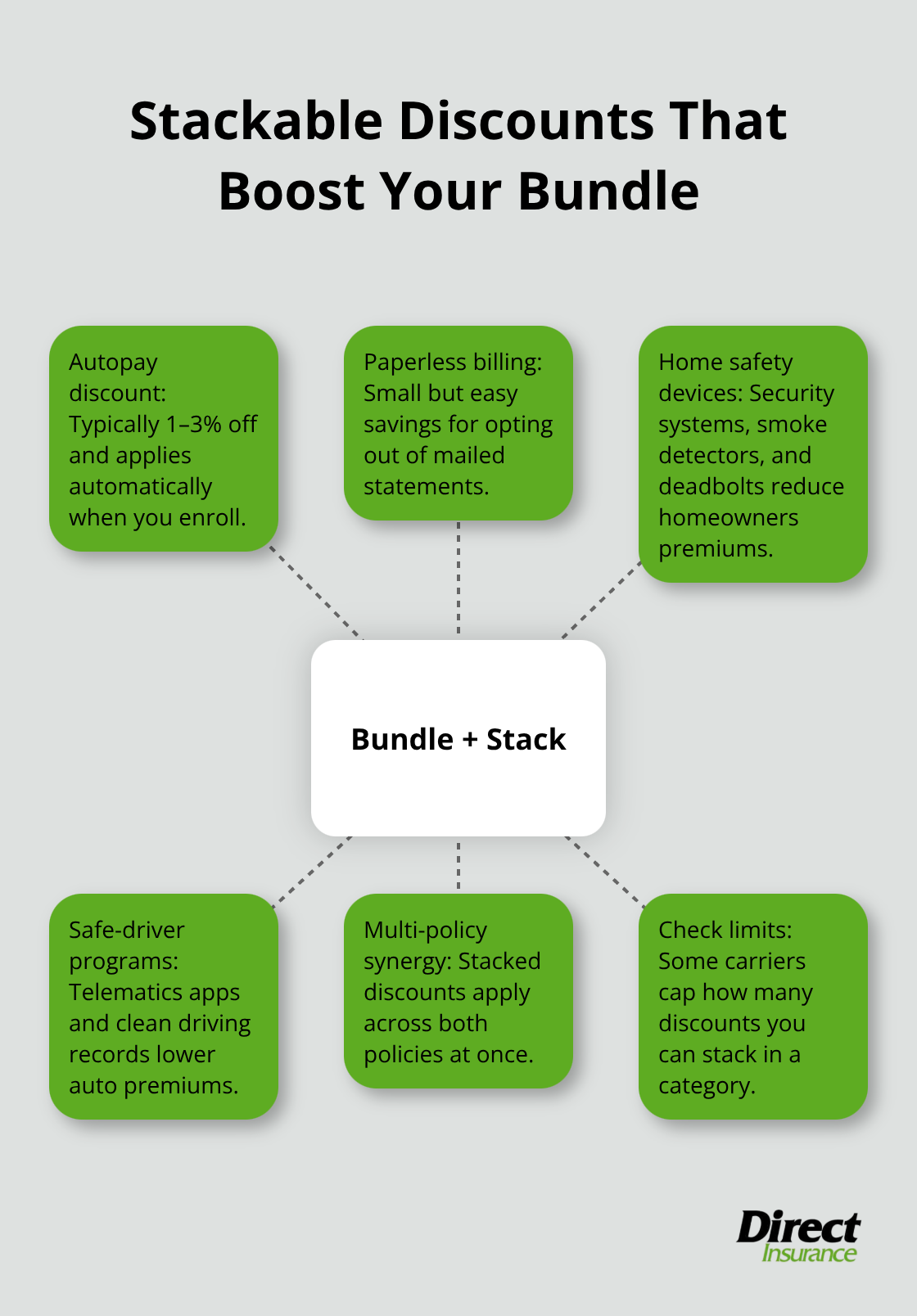
These secondary discounts are where bundling becomes even more valuable because they apply across both policies simultaneously. Ask your agent explicitly which discounts stack and which ones don’t-some carriers limit how many discounts you can claim in a single category.
Why Bundle Savings Vary So Much
Your actual savings depend on how the insurer calculates the discount. Some carriers apply a fixed percentage to both policies equally. Others tier their discounts based on risk level and property value. High-value homes or vehicles sometimes trigger different discount structures than standard properties. Deductible choices matter too. If you select a $1,000 deductible instead of $500, your premium falls, which means your bundle discount is calculated on a lower base number. Coordinating your renewal dates across both policies ensures the bundle discount applies to both at the same time. If your auto policy renews in March and your home policy renews in September, you might miss out on combined savings during the gap. Align renewal dates so discounts work together and you avoid gaps in coverage.
What Happens When You Actually Compare Quotes
Getting quotes from multiple carriers reveals which bundle truly saves you the most money. One insurer might offer a 20% discount on a $1,200 annual home premium and a $900 annual auto premium, totaling $1,980 after the discount. Another carrier might offer 15% off the same combined premium of $2,100, totaling $1,785. The second option wins, even though the discount percentage is lower. This is why comparing total costs matters far more than comparing discount percentages. Online quote tools let you enter your information once and receive bundled quotes from several carriers within minutes. You’ll see the exact dollar amount you’d pay, not just a percentage. Some carriers require agent-assisted quotes, which takes longer but often provides more detailed customization options for your specific situation.
What Real Savings Look Like When You Bundle
The numbers tell a clear story. Liberty Mutual reports that new customers switching and bundling auto and home save approximately $950 per year on average, based on a nationwide survey. State Farm customers see bundled discounts around 17%, which translates to roughly $1,429 in annual savings for some policyholders. Progressive advertises discounts up to 25% for new customers who bundle, while Travelers offers up to 15% in bundle savings.
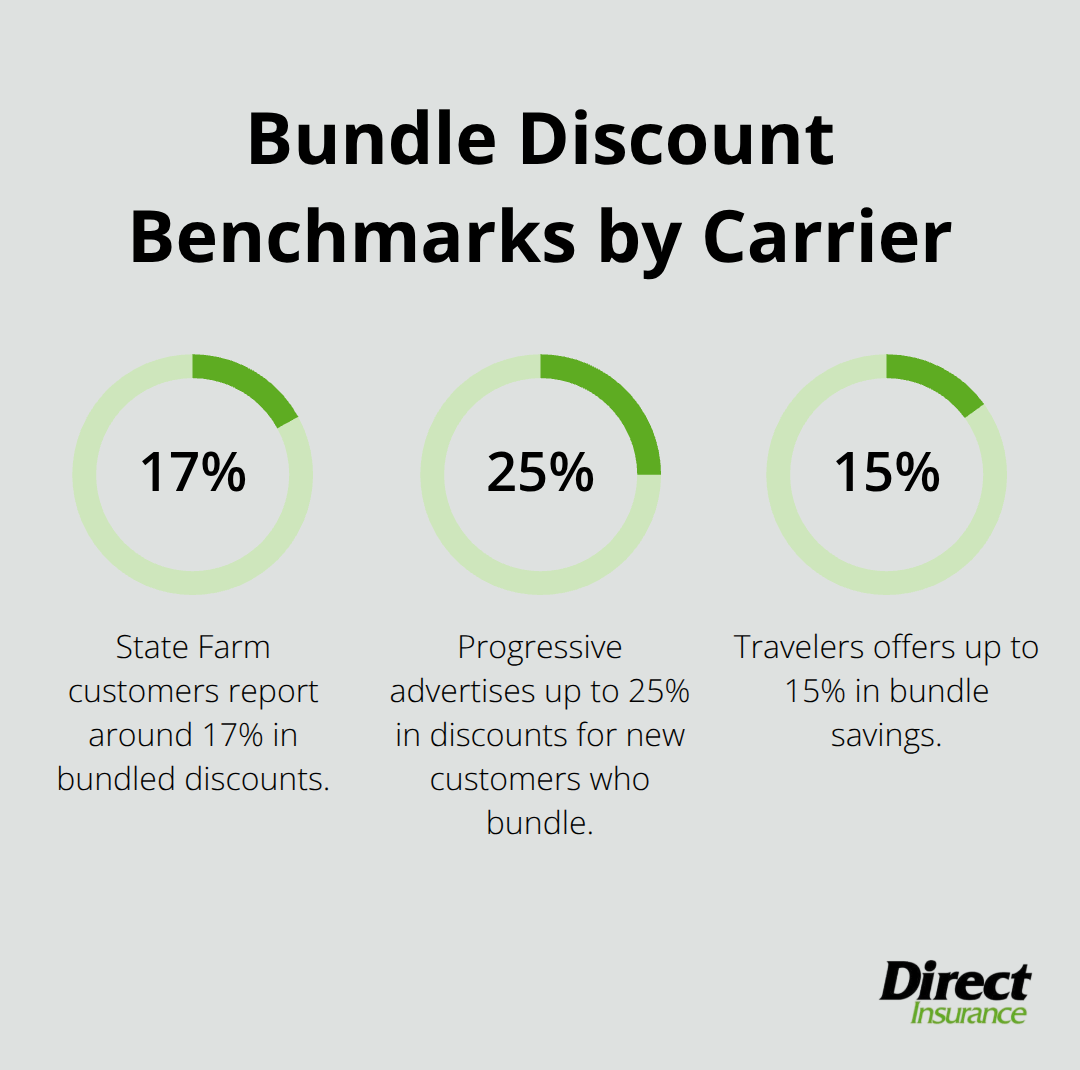
These aren’t hypothetical percentages-they’re actual dollars that real people keep in their pockets every year.
Your Situation Determines Your Actual Savings
The variation exists because your specific circumstances drive the final number. A 25-year-old driver with a clean record living in a low-crime suburb will save more than a 35-year-old with one accident living in an urban area. An older home in need of updates qualifies for smaller discounts than a newly built property with modern safety features. The only way to know your exact savings is to request quotes from at least three carriers and calculate the total cost of bundling versus buying policies separately. One carrier might beat another by $200 or $300 annually, which compounds to thousands of dollars over five years.
Bundling Often Beats Individual Policies, But Not Always
This matters: bundling doesn’t automatically guarantee the cheapest total price. Sometimes your auto rate is significantly cheaper with one company while another carrier offers a better home rate. If Carrier A quotes $1,100 for auto and $1,800 for home with a 20% bundle discount totaling $2,320, but Carrier B quotes $950 for auto alone and $1,600 for home alone totaling $2,550 unbundled, Carrier A wins even though Carrier B has cheaper individual rates. However, if Carrier C quotes $900 for auto and $1,400 for home unbundled totaling $2,300, you save $20 compared to bundling. The math requires actual numbers from your quotes, not assumptions.
Secondary Discounts Stack With Your Bundle
The secondary discounts layer on top and shift the equation further. If you qualify for autopay discounts (1–3% off), safety device discounts for your home, and a safe-driver program for your vehicle, these stack with your bundle discount. A customer with a bundled policy receiving a 20% multi-policy discount plus a 2% autopay discount plus a 5% safety device discount ends up saving far more than the base 20% suggests. These additional discounts apply across both policies simultaneously, making bundling increasingly valuable the more discounts you qualify for.
Where Additional Savings Hide
Security systems, smoke detectors, and deadbolts reduce your homeowners premium. If you install these devices before requesting quotes, your base home premium drops, which means your bundle discount is calculated on a lower foundation. A telematics app that monitors safe driving habits can reduce your auto premium by up to 30% with some carriers, though eligibility varies. Combining a telematics discount with your bundle discount produces substantial savings that most customers overlook.
Paying your premium annually instead of monthly saves money with most carriers. Maintaining continuous coverage without gaps qualifies you for loyalty discounts that increase over time. Some insurers reward customers who maintain both policies for multiple years with rate reductions or additional perks. The key is asking your agent which specific discounts apply to your situation and how they combine (some carriers restrict how many discounts you can stack in a single category, so clarification prevents surprises at renewal).
Now that you understand what real savings look like, the next step is learning how to actually compare quotes and identify which bundle works best for your home and vehicle.
Practical Steps to Bundle Your Home and Auto Insurance
Know Your Current Coverage Before You Compare
Start with what you actually have, not what you think you have. Pull out your current home and auto policies and write down three specific numbers: your annual premium for each policy and your deductible for each. Most people skip this step and waste time comparing quotes without a baseline. You need to know exactly what you’re paying now so you can measure whether a bundled quote actually saves money.
Check your policy documents for coverage limits too. Your homeowners policy should state your dwelling coverage amount, personal property limit, and liability limit. Your auto policy should show your liability limits, collision coverage, and comprehensive coverage. Write these down. When you request bundled quotes, you’ll want to match these same coverage levels across carriers so you’re comparing apples to apples, not a $300,000 dwelling limit from one insurer against a $250,000 limit from another.
If your home was built before 1980 or your vehicle is over ten years old, mention this upfront when requesting quotes because some carriers price older properties and vehicles differently, and this affects your bundle discount calculation. If you have any claims in the past three to five years, disclose them immediately. Bundled quotes change dramatically when you add a home claim or an at-fault accident, so carriers need this information to provide accurate numbers.
Request Quotes from Multiple Carriers
Requesting quotes from at least three different carriers takes roughly 30 minutes online but saves hundreds of dollars annually. Start with carriers that operate in your state and accept online quotes. Progressive, State Farm, Travelers, and Liberty Mutual all allow you to enter your information once and receive bundled quotes within minutes.
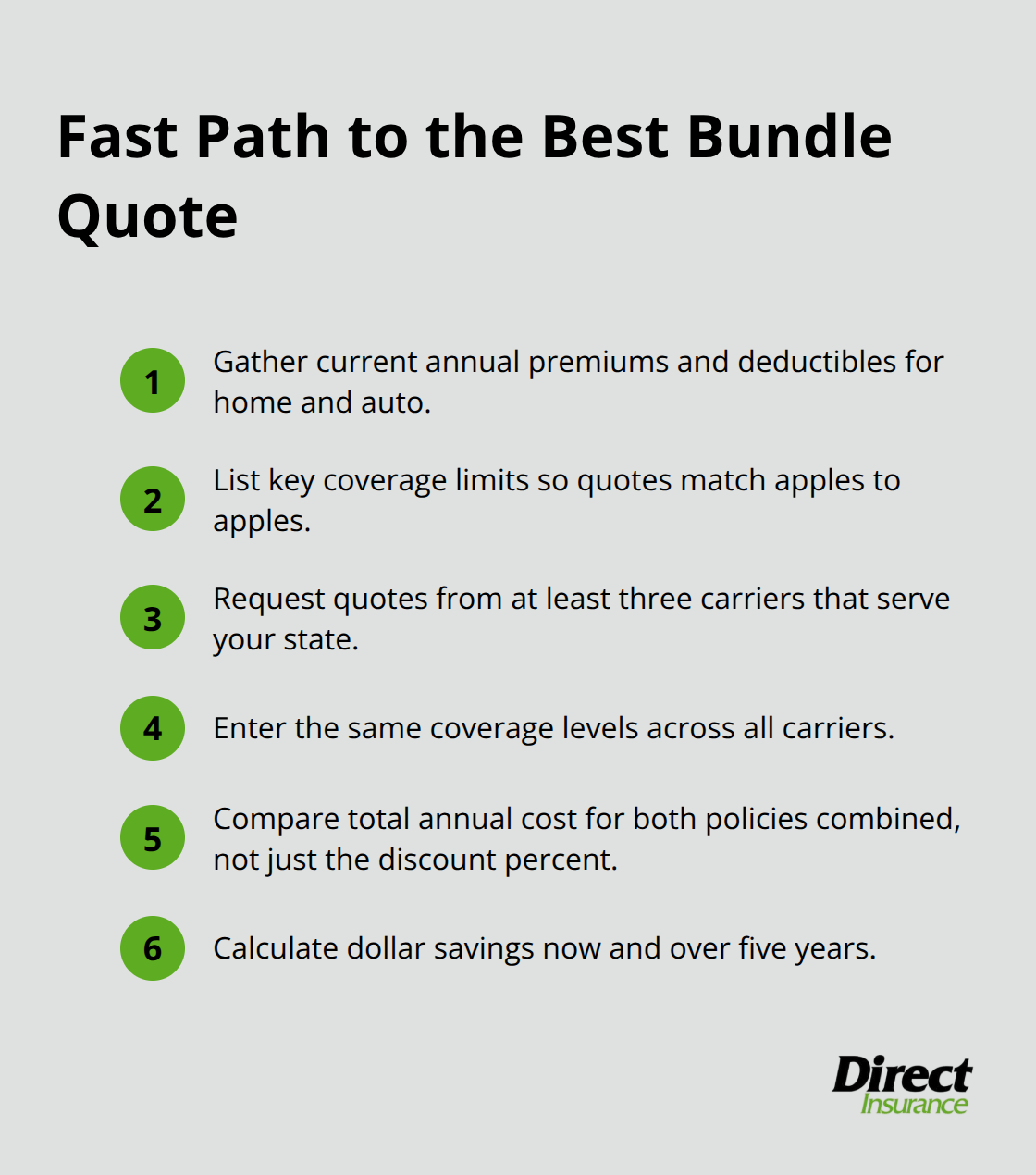
Enter your current coverage levels exactly as they appear on your existing policies so the quotes reflect your actual protection. When the quotes appear, don’t just look at the bundled discount percentage. Look at the total annual cost for both policies combined. One carrier might offer a 20% bundle discount while another offers 15%, but the carrier with the lower percentage could have a lower total cost because their base rates are cheaper.
Calculate the total premium you’d pay annually with each carrier, then subtract that from your current total premium. That number is your actual savings. If one carrier quotes $2,100 bundled and you currently pay $2,400 total, you save $300 annually. That’s $1,500 over five years.
Work with an Independent Agent for Deeper Analysis
After you’ve collected quotes from three carriers, contact a local independent agent. Independent agents have access to multiple carriers and can often find bundle options that online quote tools don’t show. An agent can also explain which secondary discounts apply to your specific situation and how they stack with your multi-policy discount.
If you qualify for a safety device discount, autopay discount, and a safe-driver program, an agent can calculate the combined impact before you commit to a policy. This matters because some carriers restrict how many discounts you can claim simultaneously, and an agent knows these limitations for each company they represent. An independent agency like Direct Insurance Services can provide this level of personalized analysis without locking you into a single carrier’s offerings.
Final Thoughts
Bundling your home and auto insurance delivers three concrete benefits: lower premiums, simplified management, and access to additional discounts that stack on top of your base savings. New customers who bundle save approximately $950 per year on average, with some seeing discounts up to 25%, and over five years that compounds to thousands of dollars you keep instead of sending to an insurance company. Beyond the money, a home and auto bundle means one renewal date, one bill, one agent to contact, and one online portal to manage both policies.
The bundle only works when you compare quotes from multiple carriers and calculate your actual total cost. Request quotes from at least three insurers, match your current coverage levels across all quotes, and compare the final annual premium, then layer in secondary discounts like autopay, safety devices, and safe-driver programs to see your true savings potential. Don’t assume the highest discount percentage wins-the lowest total annual cost is what matters.
We at Direct Insurance Services help Utah families and individuals navigate bundling without pressure or one-size-fits-all solutions. Contact Direct Insurance Services today for a personalized quote and let our experienced team show you exactly how much your home and auto bundle could save.
Disclaimer: The information provided in this blog is for general informational purposes only and does not constitute legal, financial, or insurance advice. Coverage options, terms, and availability may vary. Please consult with a licensed professional for advice specific to your situation


