Auto Insurance Deductible Options: Choosing Your Ideal Level
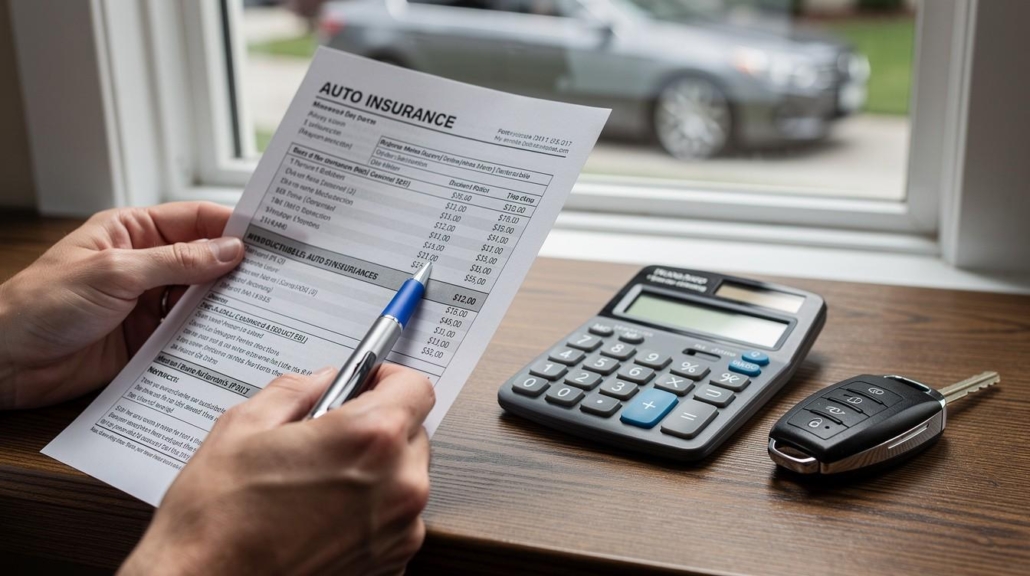
Your auto insurance deductible is one of the biggest decisions you’ll make when buying coverage. The amount you choose directly affects both your monthly premium and what you’ll pay out of pocket after an accident.
At Direct Insurance Services, we help Utah drivers find the deductible level that matches their financial situation and driving habits. This guide walks you through the options so you can make a choice that actually works for your life.
How Deductibles Actually Work
A deductible is the amount you pay out of your own pocket before your insurance company covers the rest of a claim. If you have a $500 deductible and your accident costs $3,000 to repair, you pay $500 and insurance covers $2,500. This structure reduces claims frequency and keeps premiums lower. The higher your deductible, the more financial responsibility you take on, which is why insurance companies reward that choice with lower monthly payments.
Common Deductible Amounts and Premium Savings
Most Utah drivers choose between $250, $500, $1,000, and $2,500 deductibles, though some policies allow custom amounts. The relationship between deductible and premium is direct and measurable. Increasing your deductible from $250 to $500 typically lowers your premium, while jumping to $1,000 can reduce it further. These savings compound over time, so a higher deductible might save you money annually on a standard auto policy.
Collision and Comprehensive Deductibles Work Separately
Most drivers don’t realize they can set different deductibles for collision and comprehensive coverage. Collision covers accidents with other vehicles or objects, while comprehensive handles theft, weather damage, and vandalism. You could pair a $500 collision deductible with a $250 comprehensive deductible, or select any combination that fits your situation.
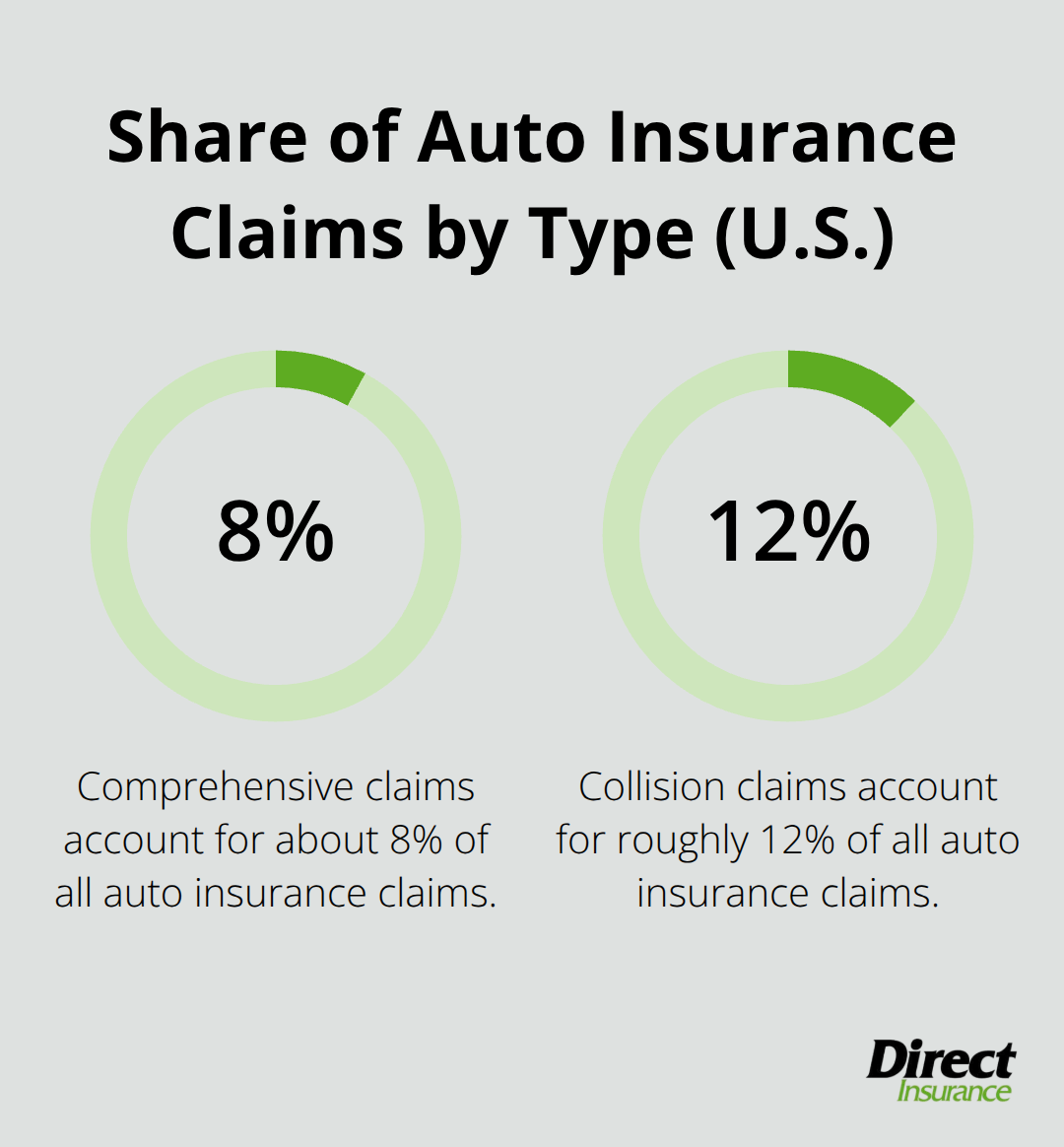
This flexibility matters because comprehensive claims happen far less frequently than collision claims. The Insurance Information Institute reports that comprehensive claims represent only about 8% of all auto insurance claims, while collision claims account for roughly 12%.
If you live in an area with low theft rates and minimal hail risk, a higher comprehensive deductible makes financial sense. Conversely, if you drive frequently on Utah highways during winter, a lower collision deductible protects you better.
Vehicle Value and Deductible Risk
Your vehicle’s actual cash value determines whether separate deductibles make sense. If your car is worth $8,000, a $2,500 deductible is risky because you’d be responsible for over 30% of your car’s value in a single accident. This mismatch between deductible and vehicle value creates financial exposure that outweighs premium savings. Understanding this relationship helps you avoid choosing a deductible that leaves you vulnerable.
Your financial situation and driving patterns shape which deductible level actually protects you best-and that’s where the next decision point becomes clear.
Factors to Consider When Choosing Your Deductible
Your Emergency Fund Determines Your Real Deductible Limit
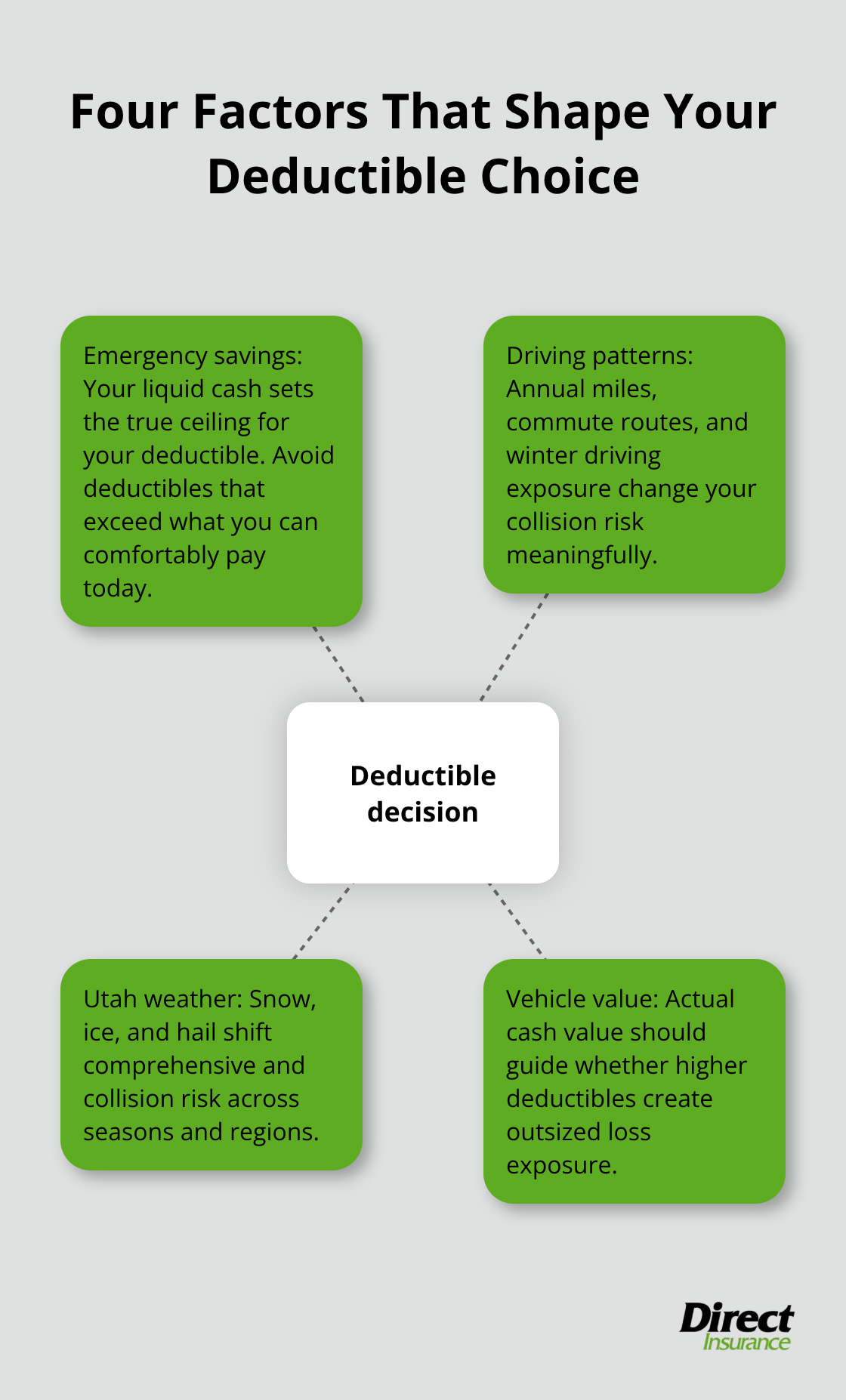
Your emergency fund sets the actual ceiling for your deductible choice, not your insurance company’s recommendations. If you have $2,000 in savings and you select a $1,500 deductible, one accident creates financial stress you can’t absorb. About 55% of Americans had enough in the bank to cover three months of expenses, which means most people shouldn’t select high deductibles regardless of the premium savings. Your deductible should never exceed one-third of your liquid savings-if you have $6,000 available, a $2,000 deductible works; if you have $3,000, stick with $500 or $1,000. This isn’t about being conservative; it’s about avoiding the trap of paying lower premiums while carrying deductible risk you can’t actually afford.
Your Actual Driving Patterns Matter More Than National Statistics
Your annual mileage and commute type determine risk far better than national accident statistics. Someone driving 5,000 miles yearly on rural Utah roads faces different collision risk than someone covering 25,000 miles on I-15 between Salt Lake City and Provo. The National Highway Traffic Safety Administration found that collision frequency increases with miles driven and urban congestion. If you drive less than 10,000 miles annually and mostly on predictable routes, a higher collision deductible makes sense because your accident probability is genuinely lower. Conversely, if you’re driving during winter months regularly, you should lower that collision deductible because Utah’s weather creates measurable risk increases. Winter driving accounts for a significant portion of Utah’s accident claims, particularly in mountain passes and valley areas prone to black ice. Track your actual driving behavior for one month-total miles, road types, and time of day-then use that data to inform your deductible choice rather than guessing.
Utah’s Weather Patterns Shift Your Comprehensive Deductible Strategy
Winter in Utah means comprehensive claims spike during December through March, particularly in areas receiving heavy snow or experiencing temperature fluctuations. If you live in Salt Lake City, Park City, or other mountain communities, hail damage and weather-related claims represent real financial risk. A $250 comprehensive deductible costs more monthly but protects you when spring hail or winter storms hit. Conversely, if your vehicle sits in a garage in a low-theft area with minimal hail exposure, a $1,000 comprehensive deductible reduces your premium without meaningful risk because those claims genuinely happen rarely for your situation.
Vehicle Age and Value Shape Your Deductible Math
Vehicle age shifts the deductible calculation significantly. A 2015 vehicle worth $12,000 justifies a lower comprehensive deductible because major hail damage could cost $4,000 to $6,000 in repairs. A 2008 vehicle worth $4,000 might not warrant expensive comprehensive coverage at all, let alone a low deductible, because the repair cost could approach total loss value. Your vehicle’s actual cash value determines whether separate deductibles make sense-if your car is worth $8,000, a $2,500 deductible is risky because you’d be responsible for over 30% of your car’s value in a single accident. This mismatch between deductible and vehicle value creates financial exposure that outweighs premium savings, and understanding this relationship helps you avoid selecting a deductible that leaves you vulnerable.
These four factors-your savings, your driving reality, Utah’s weather patterns, and your vehicle’s worth-work together to point you toward the deductible strategy that actually fits your life. The next step involves matching these factors to specific deductible strategies that balance premium costs with real protection.
Common Deductible Strategies
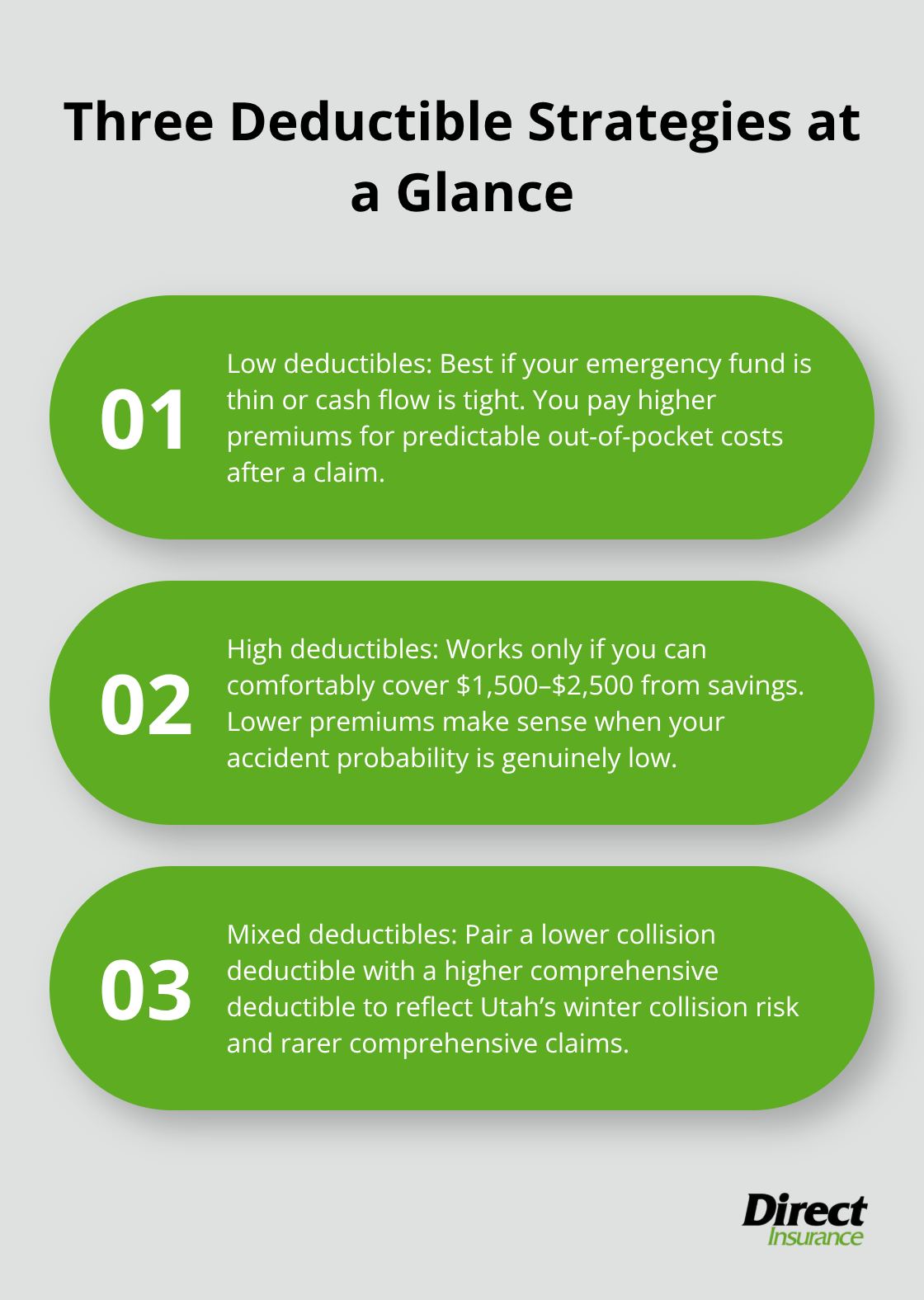
The deductible strategy you select depends less on what sounds good and more on what actually aligns with your financial reality and accident probability. The three approaches-low, high, and mixed deductibles-each solve different problems, and understanding which problem you’re actually facing makes the choice straightforward.
Low Deductibles Protect People with Thin Financial Margins
A $250 or $500 deductible makes sense if your emergency fund sits below $3,000 or if you’d struggle paying $1,000 out of pocket after an accident. You trade higher monthly premiums for predictable out-of-pocket costs that won’t derail your finances. This strategy works particularly well for Utah drivers under 25 or over 65, who statistically experience higher accident rates according to the National Highway Traffic Safety Administration. If you commute daily on I-15 between Salt Lake City and Provo, or if you drive regularly during winter months, the accident probability justifies absorbing higher premiums to keep your deductible low. The math here favors predictability over savings-you pay more monthly but know exactly what you’ll pay if an accident happens, and that certainty matters when your financial cushion is small.
High Deductibles Work Only If Your Emergency Fund Can Absorb the Hit
A $1,500 or $2,500 deductible saves real money on premiums (often 30 to 40 percent compared to a $250 deductible), but only if you have $5,000 or more in accessible savings. This strategy assumes you drive safely, have solid accident avoidance habits, and can genuinely afford to pay the deductible without borrowing. If you drive fewer than 10,000 miles annually, mostly on predictable routes outside winter weather windows, this approach makes financial sense because your actual accident probability is low. The trap most drivers fall into involves selecting a high deductible based on premium savings alone, then discovering they can’t afford it when an accident happens. Calculate the annual premium savings first, then ask yourself honestly whether you’d actually pay that deductible without financial stress. If the answer involves credit cards or loans, your deductible is too high.
Mixed Deductibles Balance Protection Where It Matters Most
Setting a lower collision deductible ($500) with a higher comprehensive deductible ($1,000) reflects Utah’s actual risk profile. Winter driving creates genuine collision risk, particularly in mountain communities and along I-80 near Park City, where black ice and snow cause frequent accidents. Comprehensive claims happen far less often-only about 8 percent of all auto insurance claims-so a higher comprehensive deductible reduces your premium without meaningful risk increase. This strategy works best if you have $3,000 to $4,000 in emergency savings and want to protect yourself where accidents are statistically more likely while accepting higher deductibles where claims are genuinely rare. If your vehicle is worth $10,000 and sits in a secure garage, but you drive winter roads regularly, this mixed approach gives you affordable collision protection without overpaying for comprehensive coverage you’ll rarely use.
Final Thoughts
Your auto insurance deductible options depend on three factors: your emergency savings, your actual driving patterns, and your vehicle’s value. If you have $5,000 in accessible savings and drive safely on predictable routes, a $1,000 deductible makes financial sense. If your emergency fund sits below $3,000 or you drive winter roads regularly, a $250 or $500 deductible protects you better despite higher premiums.
Start by reviewing your current policy this week and pull your declarations page to write down your current deductible amounts for both collision and comprehensive coverage. Then calculate your actual emergency fund balance and track your driving for one month to see your real mileage and road types. Compare these numbers against the strategies outlined here, and you’ll see which option actually fits your situation.
An independent insurance agent can walk through your specific circumstances and show you the actual premium differences between deductible levels, then help you select the option that balances protection with affordability. At Direct Insurance Services, we work with top-rated carriers to show you multiple coverage options without pushing you toward one-size-fits-all solutions. Contact us to review your current deductible and explore whether adjustments would save you money or provide better protection for your situation.
Disclaimer: The information provided in this blog is for general informational purposes only and does not constitute legal, financial, or insurance advice. Coverage options, terms, and availability may vary. Please consult with a licensed professional for advice specific to your situation


