Contractor Insurance Requirements Utah: What You Need to Meet
Running a contracting business in Utah means navigating specific insurance rules. State law requires certain coverage types, and skipping them puts your business at serious financial risk.
At Direct Insurance Services, we help contractors understand exactly what contractor insurance requirements Utah demands. Getting the right coverage protects your assets and keeps your license valid.
What Coverage Does Utah Law Actually Require?
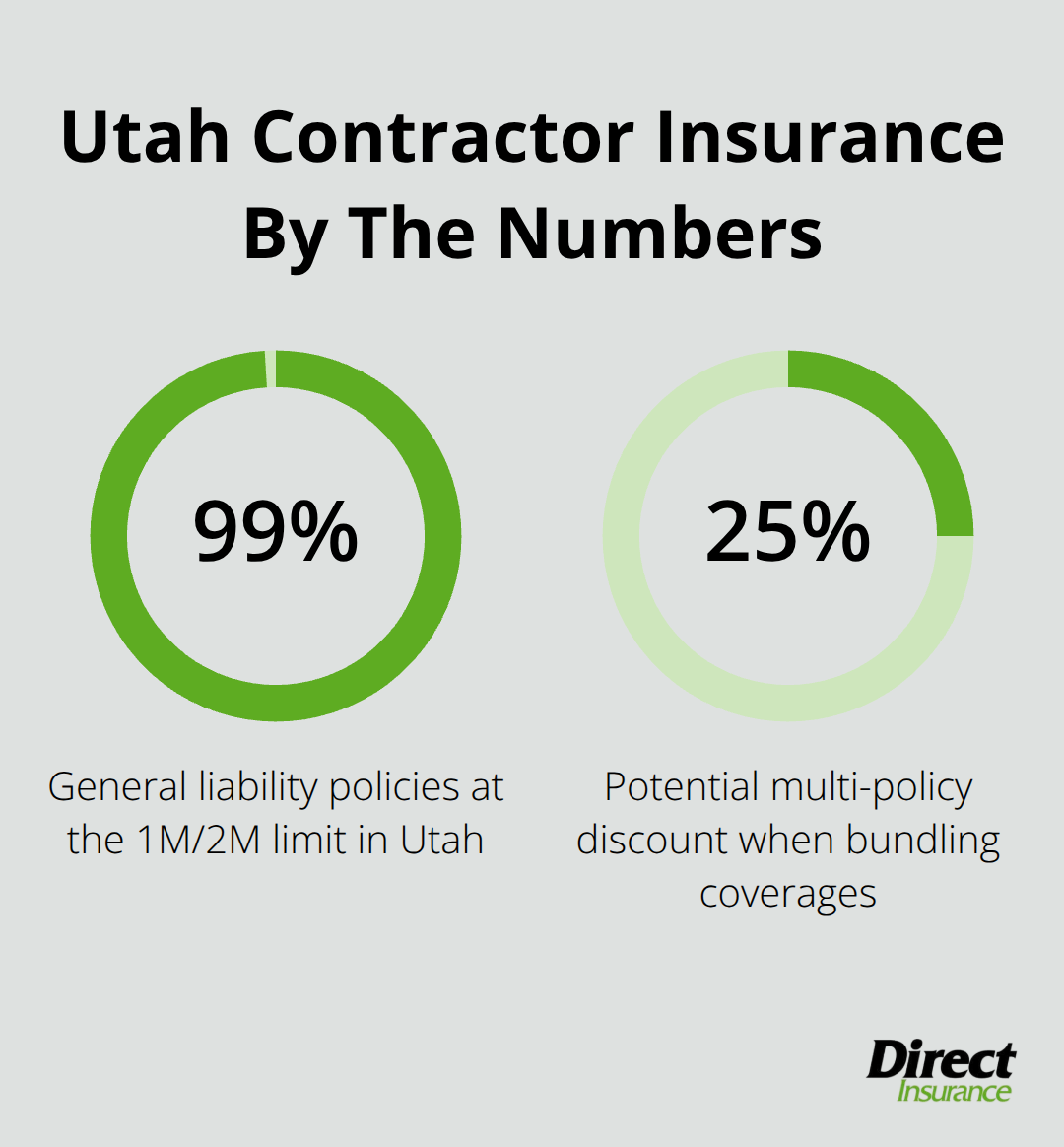
Utah’s construction industry operates under strict insurance mandates, and there’s no flexibility here. If you’re running a contracting business in Utah, state law requires general liability insurance as baseline protection. This coverage protects against bodily injury, property damage, and personal/advertising injury claims on the job site. The standard minimum coverage level in Utah is 1,000,000 per occurrence and 2,000,000 aggregate, commonly written as 1M/2M. About 99% of general liability policies sold in Utah sit at this exact level because it satisfies both state requirements and client demands from project owners and lenders.
Workers’ Compensation Becomes Mandatory With Employees
Hiring even a single employee in Utah triggers a legal requirement for workers’ compensation insurance. This isn’t optional-the state mandates it, and operating without it exposes you to massive financial liability. Workers’ compensation covers medical expenses, lost wages, and potential permanent disability for injured workers. Without this coverage, you personally absorb these costs out of pocket. Medical bills can reach tens of thousands of dollars for serious injuries, and wage replacement obligations continue for months. The actual cost of workers’ comp varies significantly by trade. Roofers and demolition contractors pay substantially more than painters or landscapers because their work carries higher injury risk. Your payroll size also matters; a solo contractor pays far less than a business with five employees on the same trade classification.
Commercial Auto Insurance for Business Vehicles
Any vehicle you use for business purposes in Utah must carry commercial auto insurance rather than personal coverage. This is non-negotiable. Personal auto policies specifically exclude business use, so you remain completely uninsured if something happens while you transport materials or visit a job site. Commercial auto typically includes property damage, bodily injury, and liability coverage. Most Utah contractors benefit from collision and comprehensive coverage as well, especially if you transport expensive equipment or tools. A recommended auto liability limit is 1,000,000 Combined Single Limit for both bodily injury and property damage combined.
License Requirements Connect to Insurance Proof
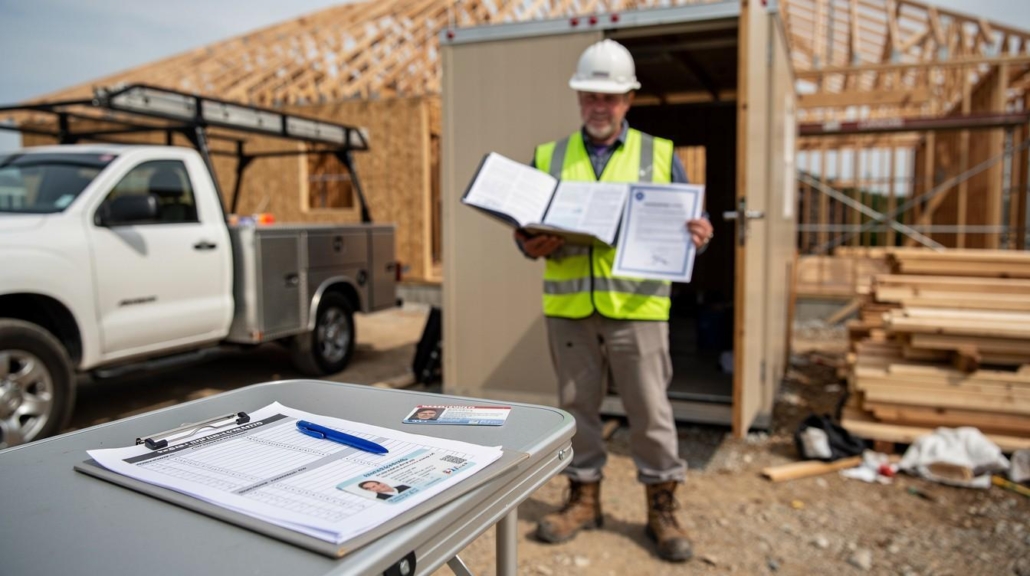
Utah requires licensed general and specialty contractors to carry general liability insurance as a condition of maintaining their license. This means your insurance isn’t just financial protection-it’s a legal requirement to operate legally. When you bid on projects or secure permits, clients and government agencies frequently request ACORD certificates as proof of current coverage. These standardized documents show your coverage is active and at adequate limits. You should keep a current ACORD certificate on hand at all times. Beyond general liability, if you hire subcontractors or employees, you’ll need workers’ compensation documentation as well. Some projects demand additional coverages like builders risk insurance for construction projects or professional liability for design-build work.
Coverage Limits Scale With Project Risk
Higher-risk situations justify higher coverage limits. A $5 million commercial project requires different protection than a $50,000 residential job. The complexity and value of your work determine how much coverage you actually need to protect your business from catastrophic loss. Understanding these distinctions helps you avoid both underinsurance and unnecessary overpayment. Once you know what Utah law requires, the next step involves finding the right carrier and comparing quotes to lock in competitive rates.
The Three Core Coverages Every Utah Contractor Must Understand
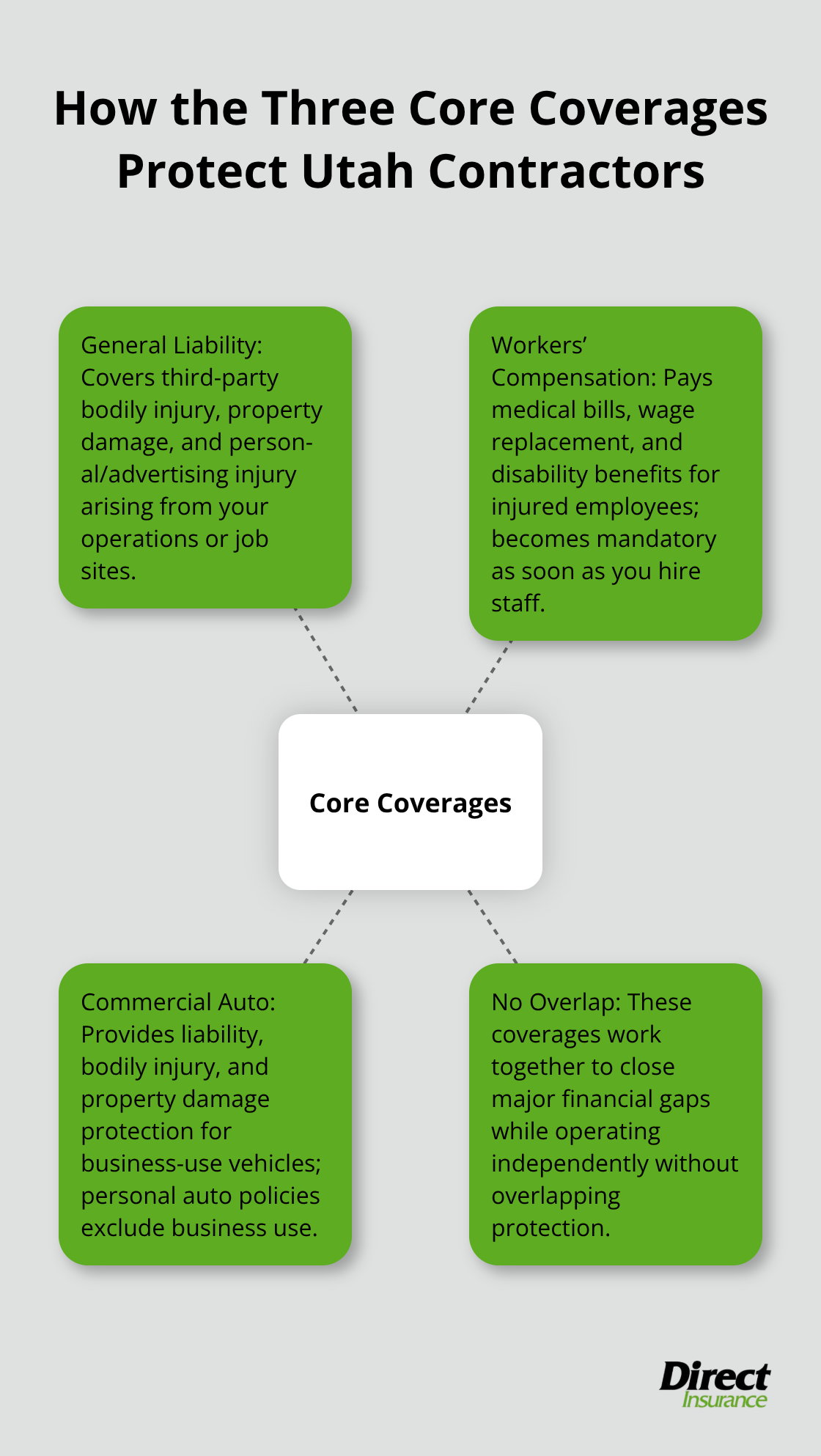
General liability, workers compensation, and commercial auto form the foundation of contractor insurance in Utah, but each serves a completely different purpose and protects against distinct financial threats. General liability shields your business when someone claims you damaged their property or caused them bodily injury on a job site. A $500,000 property damage claim from a client whose home you accidentally flooded during renovation work would devastate an uninsured contractor. Workers compensation covers your employees when they get hurt, and this is where contractors often underestimate their actual exposure. A single serious injury can generate $100,000 or more in medical bills and wage replacement costs spanning months. Commercial auto insurance is mandatory whenever you use a vehicle for business, and personal auto policies explicitly exclude business use, leaving you completely exposed if you’re in an accident while transporting materials or traveling between jobs. These three coverages work together to prevent catastrophic financial loss, but they operate independently and none overlaps with the others.
General Liability Costs Less Than You Think
General liability insurance for contractors typically costs between $750 and $2,500 annually for small-to-mid-sized contractors with a standard $1M/$2M policy. The actual premium depends on your trade classification, with lower-risk trades like painting and landscaping paying substantially less than higher-risk work like roofing or demolition. A solo painter might pay less per year while a roofing contractor with three employees could pay toward the higher end for the same coverage limits. The 1M/2M standard that dominates Utah contracting exists because it satisfies state requirements, client demands, and lender requirements simultaneously, so shopping for lower limits rarely saves money and creates serious gaps in protection. Some contractors attempt to avoid general liability by working as solo operators, but this strategy fails instantly when a client demands ACORD certificates before you start work or when a single incident threatens your business existence.
Workers Compensation Varies Dramatically by Trade and Payroll
Workers compensation insurance costs fluctuate wildly depending on what type of work you perform and how many employees you have. A roofing contractor with five employees pays significantly more than an electrician with the same crew size because roofing carries higher injury frequency and severity. HVAC contractors, plumbers, and electricians typically fall in the moderate-cost range, while general contractors overseeing multiple trades often pay premium rates. Payroll size matters enormously-your premium scales directly with how much you pay your employees, so adding a second worker increases your cost substantially. A contractor with $200,000 in annual payroll pays roughly double what a solo operator pays for the same coverage. Clean claims history reduces your rates, so avoiding worker injuries directly saves money on future premiums. Many Utah contractors overlook that workers compensation covers not just medical expenses but also permanent disability benefits, which can run into hundreds of thousands of dollars for catastrophic injuries.
Commercial Auto Insurance Requires Specific Business Endorsements
Personal auto insurance explicitly excludes business use, which means you have zero coverage if you’re involved in an accident while transporting equipment or traveling to a job site. Commercial auto policies provide the coverage you actually need, including property damage, bodily injury, and liability protection. A 1,000,000 Combined Single Limit protects both bodily injury and property damage combined, which is the standard most Utah contractors should carry. Collision and comprehensive coverage protects your own vehicle from damage, and contractors with expensive equipment or tools in their vehicles should absolutely carry these additions. Your premium depends on the vehicle type, driving records of anyone operating company vehicles, and the distance you travel for work. A contractor who drives five miles across town occasionally pays far less than someone who travels statewide regularly. If you have employees driving company vehicles, their driving records affect your rates, so hiring safe drivers directly reduces your insurance costs.
Finding the Right Coverage for Your Situation
The three core coverages protect different aspects of your contracting business, but determining the right limits and add-ons requires honest assessment of your actual operations. Your trade classification, payroll size, vehicle usage, and project types all influence what you truly need. Once you understand these fundamentals, the next step involves comparing quotes from multiple carriers to find coverage that matches both your requirements and your budget.
Getting Contractor Insurance in Utah
At Direct Insurance Services, we work with contractors daily who struggle with the actual mechanics of purchasing insurance. The process feels overwhelming, but breaking it into concrete steps eliminates the confusion. You need to know exactly what to expect when shopping for coverage, how to compare quotes accurately, and what policy language actually means for your business protection.
Start With an Independent Agent Who Understands Utah Contracting
An independent insurance agent changes everything because they represent your interests, not a single insurance company’s bottom line. An independent agent in Utah accesses multiple carriers and shows you real premium differences across providers for identical coverage. This matters enormously because general liability rates for the same 1M/2M policy can vary by 30 to 40 percent between carriers, meaning an agent can save you hundreds of dollars annually just through carrier selection.
When you call an agent, have your business details ready: your trade classification, annual payroll if you have employees, number of years in business, and your claims history. Agents who specialize in contractor insurance understand Utah’s specific requirements and know which carriers offer the best rates for your particular trade. A roofing contractor needs an agent who understands roofing risks, not someone selling generic commercial policies.
Ask potential agents directly how many contractor clients they serve and whether they work with carriers that specialize in construction trades. An agent should explain why one carrier costs more than another for seemingly identical coverage, usually because of underwriting philosophy or claims experience in your specific trade. Utah contractors report that working with someone who understands their work reduces confusion and prevents coverage gaps that emerge later when claims happen.
Gather Quotes From Multiple Carriers
Never accept the first quote you receive because premium variation between carriers is substantial and predictable. Request quotes from three to five different carriers using identical coverage specifications: same liability limits, same deductibles, same add-on coverages. This forces apples-to-apples comparison instead of getting confused by different policy structures.
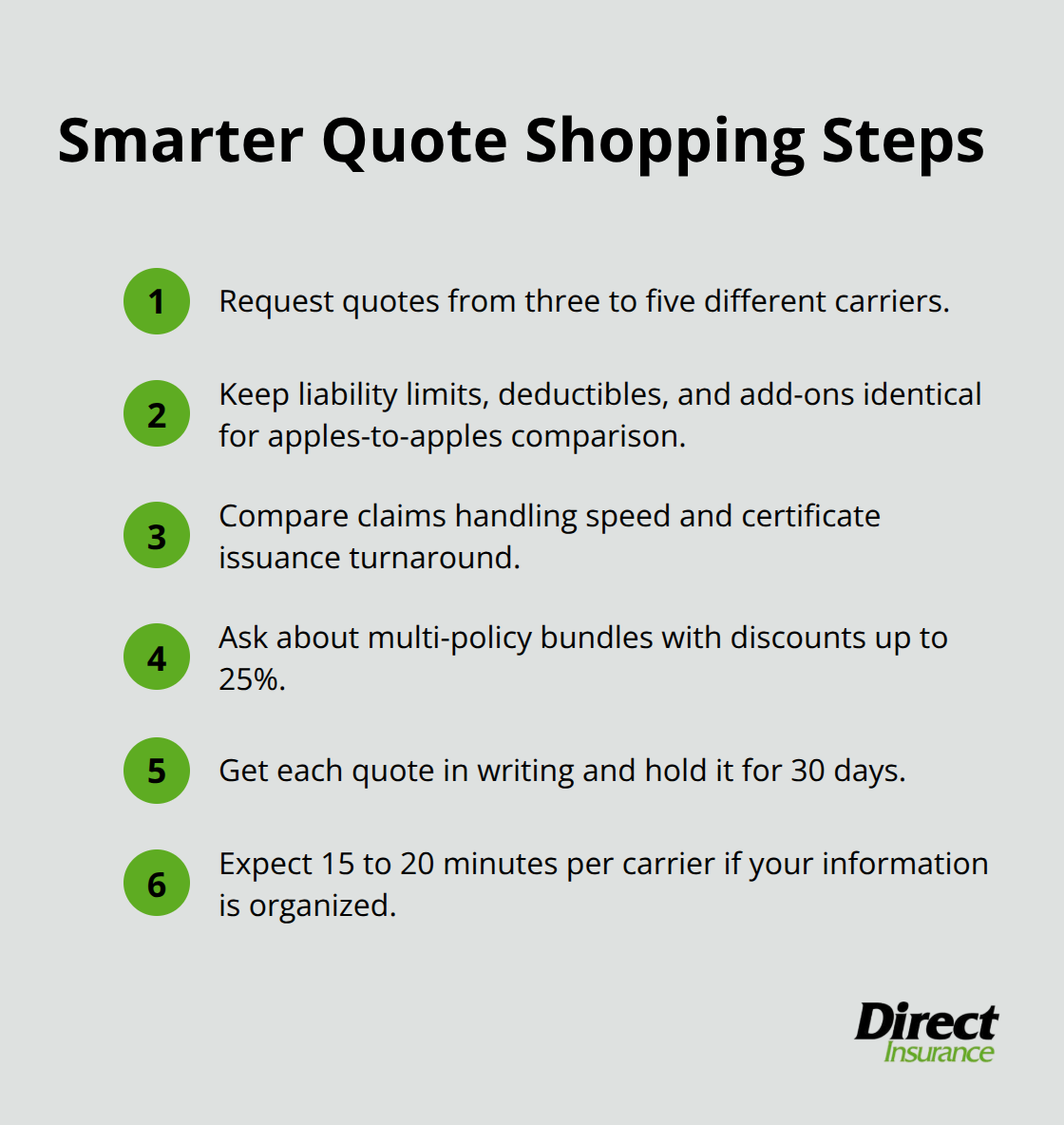
When you receive quotes, the lowest price isn’t automatically the best choice because some carriers are aggressive on pricing but slower on claims handling, while others charge more but have superior customer service records. Ask each carrier about their average claim response time and whether they offer same-day certificate issuance, which matters when you need ACORD documents quickly for permit applications or job starts.
Some carriers bundle general liability, workers compensation, and commercial auto together at discounts reaching 25 percent compared to purchasing policies separately, so always ask about multi-policy discounts. Get a quote in writing and keep it for at least 30 days while you make your decision. Expect the quote process to take 15 to 20 minutes per carrier if your information is organized. Online quote tools work for general liability but workers compensation and commercial auto typically require direct agent interaction because the underwriting involves more questions about your specific operations.
Understand What Your Policy Actually Covers and What It Excludes
Policy language determines whether you’re protected or exposed when claims happen, but most contractors never read their actual policies. After you select a carrier, request a specimen policy and read the coverage sections, exclusions, and conditions before signing anything.
General liability policies exclude certain work like waterproofing, asbestos work, and pollution liability, so understand whether your specific services are covered or require endorsements. Workers compensation has few exclusions in Utah, but independent contractors and sole proprietors are typically excluded from coverage even if you hire them, meaning you need different protection structures if you use subcontractors regularly. Commercial auto policies exclude coverage for contractors who operate as common carriers or haul materials for hire, which matters if you transport materials as part of your service offering.
Ask your agent to explain three specific things: what happens if someone claims you caused injury but the injury wasn’t immediately obvious, what the process is for filing a claim, and whether coverage limits apply per occurrence or annually. Some contractors discover too late that their policy has a contractual liability exclusion, meaning they can’t claim coverage for damages they contractually promised to cover in their project agreements.
Request endorsements like contractual liability coverage, hired and non-owned auto coverage if employees drive personal vehicles for work, and tools and equipment coverage if you leave equipment on job sites. The policy document itself is the contract, not the marketing materials or agent explanations, so understanding it prevents nasty surprises when you actually need coverage.
Final Thoughts
Utah’s contractor insurance requirements protect your business from financial catastrophe, and skipping coverage exposes you to claims that exceed six figures. A single serious injury to an employee or property damage claim from a client destroys contracting businesses operating without proper protection. General liability, workers compensation, and commercial auto insurance satisfy state law, client demands, and lender requirements simultaneously, making them non-negotiable investments in your business survival.
Working with an independent agent who understands Utah contracting saves hundreds of dollars annually because premium variation between carriers for identical coverage reaches 30 to 40 percent. Read your actual policy documents before signing anything because exclusions determine whether you’re protected or exposed when claims happen. Request endorsements like contractual liability coverage and tools and equipment protection based on your specific operations and job site risks.
We at Direct Insurance Services help Utah contractors secure the contractor insurance requirements Utah demands while matching your business needs and budget. Get a quote today and protect your contracting business with coverage that actually works when you need it.
Disclaimer: The information provided in this blog is for general informational purposes only and does not constitute legal, financial, or insurance advice. Coverage options, terms, and availability may vary. Please consult with a licensed professional for advice specific to your situation

