How Full coverage snowmobile Utah Helps You Understand Coverage Limits
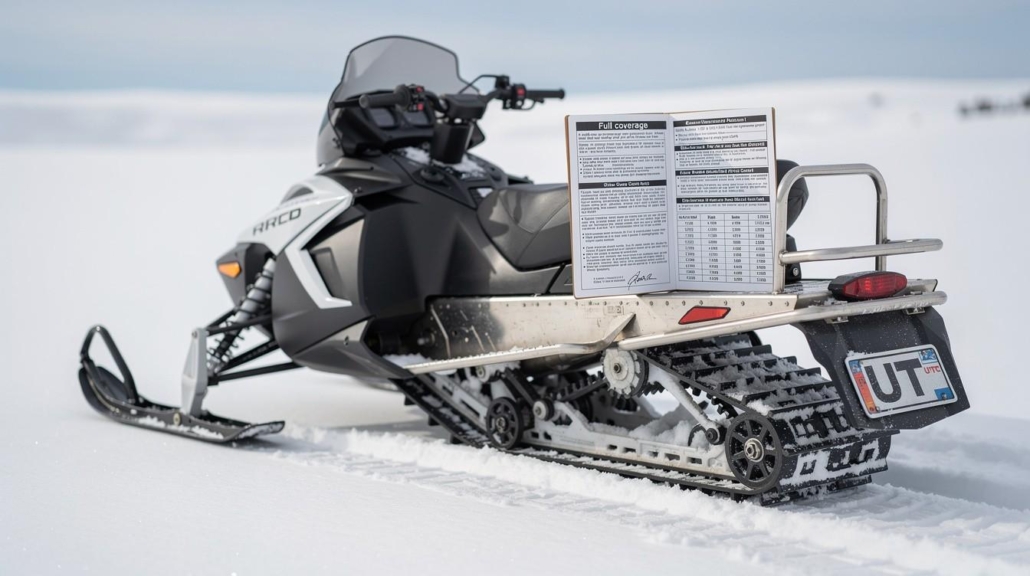
Snowmobile accidents in Utah’s backcountry can cost tens of thousands of dollars in medical bills and equipment damage. Most riders don’t realize that full coverage snowmobile Utah policies have specific limits that might leave you financially exposed.
At Direct Insurance Services, we’ve seen too many riders discover their coverage falls short after an accident. Understanding your coverage limits now means protecting your finances and your riding future.
What Full Coverage Actually Means for Utah Snowmobilers
Full Coverage Isn’t Unlimited Protection
Full coverage snowmobile insurance doesn’t mean you’re protected against everything. It means you have multiple types of coverage working together, but each type has a maximum dollar limit. When you hit that limit, you stop receiving benefits. Utah riders often assume full coverage means unlimited protection, then face serious financial gaps after an accident.
Underinsured motorists file claims more often than adequately insured ones. Snowmobilers face even steeper risks given the terrain and speeds involved in Utah’s backcountry. Full coverage typically includes collision protection (covers damage when your snowmobile hits something), comprehensive protection (covers theft, weather damage, and vandalism), and liability coverage (covers injuries or property damage you cause to others).
How Limits Work in Your Policy
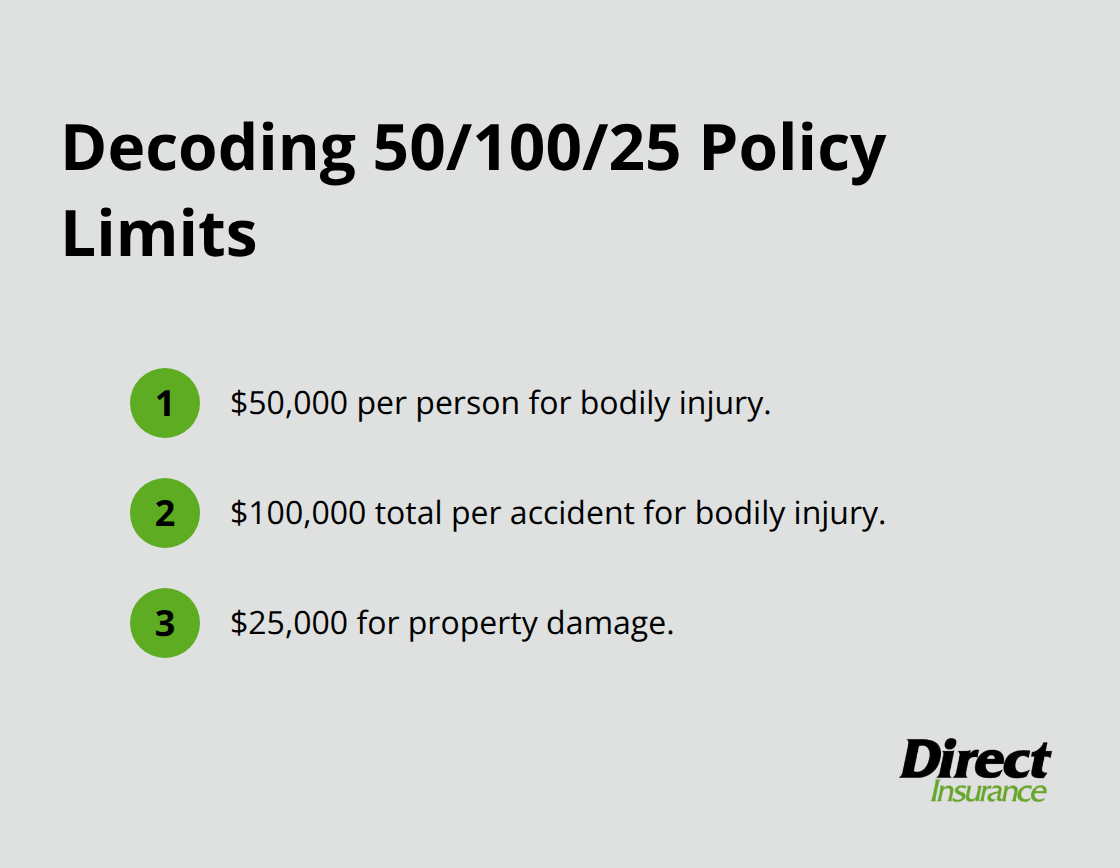
Your policy document lists specific limits for each type, often shown as numbers like 50/100/25. This means $50,000 per person for bodily injury, $100,000 total per accident, and $25,000 for property damage. These limits are negotiable when you purchase your policy, but many riders accept default limits without understanding how quickly medical costs and equipment replacement can exceed them.
Why Coverage Limits Determine Your Financial Exposure
A serious injury claim in Utah can exceed $100,000 in medical costs alone. If your liability limit sits at $50,000 per person, you become personally responsible for the remaining $50,000 or more. Collision coverage limits work the same way-if your snowmobile is worth $15,000 but your collision limit is only $10,000, you absorb the $5,000 gap.
Utah’s mountain terrain creates higher accident severity compared to flat-terrain riding, making adequate limits essential rather than optional. Riders who frequently venture into remote backcountry areas face different risks than those staying on groomed trails, and your limits should reflect that reality. The cost difference between a $50,000 liability limit and a $100,000 limit is often just $100 to $200 annually, yet that difference can mean the distinction between financial security and serious debt after an accident.
Assessing Your Personal Risk Profile
Your specific exposure depends on where you ride, your experience level, and your personal financial capacity to cover gaps. A local independent insurance agent can help you evaluate these factors and recommend appropriate limits for your situation. This assessment becomes your foundation for selecting coverage that actually protects your finances rather than leaving you exposed.
Why Coverage Limits Matter in Utah’s Backcountry
The Real Cost of Backcountry Accidents
Utah snowmobilers face accident costs that dwarf national averages. A single emergency helicopter rescue in Utah’s mountains runs $15,000 to $25,000 before any medical treatment begins. Add trauma surgery, ICU stays, and rehabilitation, and medical bills routinely exceed $150,000 for serious accidents. Equipment damage compounds the problem-replacing a damaged snowmobile plus gear easily reaches $8,000 to $12,000.
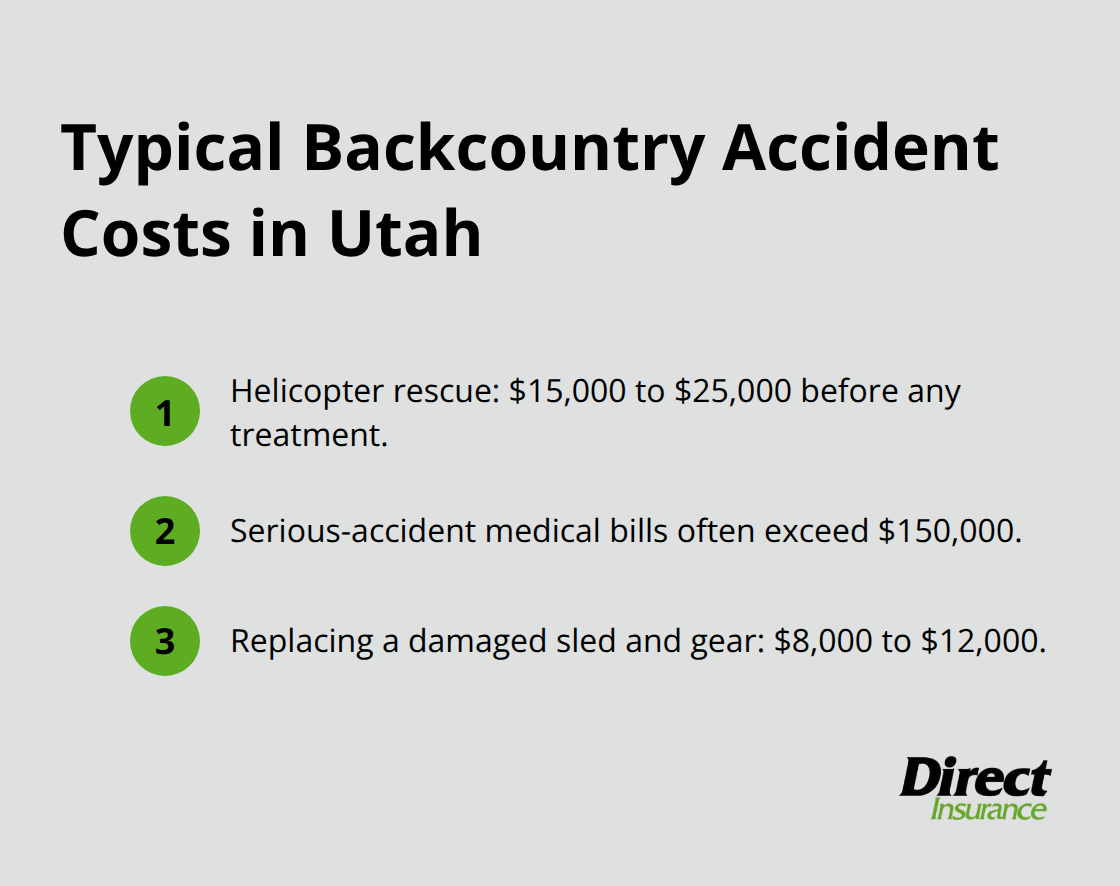
Riders often think their coverage is sufficient, only to discover their limits cover less than half the actual costs. The gap between what your policy pays and what you owe becomes your personal debt.
How Mountain Terrain Amplifies Your Risk
Utah’s steep backcountry terrain and high-altitude riding conditions produce more severe accidents than groomed trail riding. A collision at 40 mph in deep snow generates different injury patterns than flat-ground accidents, often requiring specialized trauma care that costs significantly more. When your liability limit is $50,000 but medical costs reach $120,000, the injured party can pursue a personal lawsuit against you for the remaining $70,000. Your wages become garnishable, your assets become vulnerable, and that $100 to $200 annual premium difference you skipped suddenly looks like the worst financial decision you made.
Utah riders who venture into remote areas like the Uinta Mountains or Bear Lake backcountry face particularly high severity risks. These zones see rescue operations that add thousands to final claim costs before medical expenses even factor in. Underinsurance in mountain terrain creates cascading financial damage that extends far beyond the accident itself.
Long-Term Financial Consequences of Underinsurance
Insufficient coverage impacts your finances long after the accident settles. Medical debt in Utah follows collection laws that allow creditors to pursue judgments for seven years or longer. A $50,000 shortfall on a claim doesn’t disappear; it becomes a lien against your home or a garnishment against your paycheck. Insurance companies report that underinsured snowmobilers in mountain states experience financial hardship lasting 5 to 10 years after major accidents.
Assess your actual net worth and compare it against your policy limits. If your limits are lower than your assets, you’re essentially self-insuring the gap. Riders in Utah’s backcountry should carry minimum liability limits of $100,000 per person and $300,000 per accident, with collision limits matching their snowmobile’s actual cash value plus 20 percent for replacement equipment.
Finding Coverage That Matches Your Riding Reality
Your specific exposure depends on where you ride, your experience level, and your personal financial capacity to cover gaps. A local independent insurance agent can help you evaluate these factors and recommend appropriate limits for your situation. This assessment becomes your foundation for selecting coverage that actually protects your finances rather than leaving you exposed.
As you prepare to customize your policy, understanding how deductibles and premium costs interact with your coverage limits becomes the next critical step in protecting yourself.
Matching Your Limits to Your Actual Riding Exposure
Track Your Riding Patterns to Set Appropriate Limits
Your riding habits dictate the coverage limits you actually need, and most Utah snowmobilers either overinsure or dangerously underinsure based on guesswork rather than facts. Start with an entire season of tracking-note the percentage of time you spend on groomed trails versus backcountry terrain, your average riding distance per outing, and whether you ride alone or in groups. Riders who spend 80 percent of their time on groomed trails near populated areas face fundamentally different risks than those who tackle remote mountain passes multiple times weekly. Your exposure in the Uinta Mountains differs sharply from riding near Park City resort boundaries.
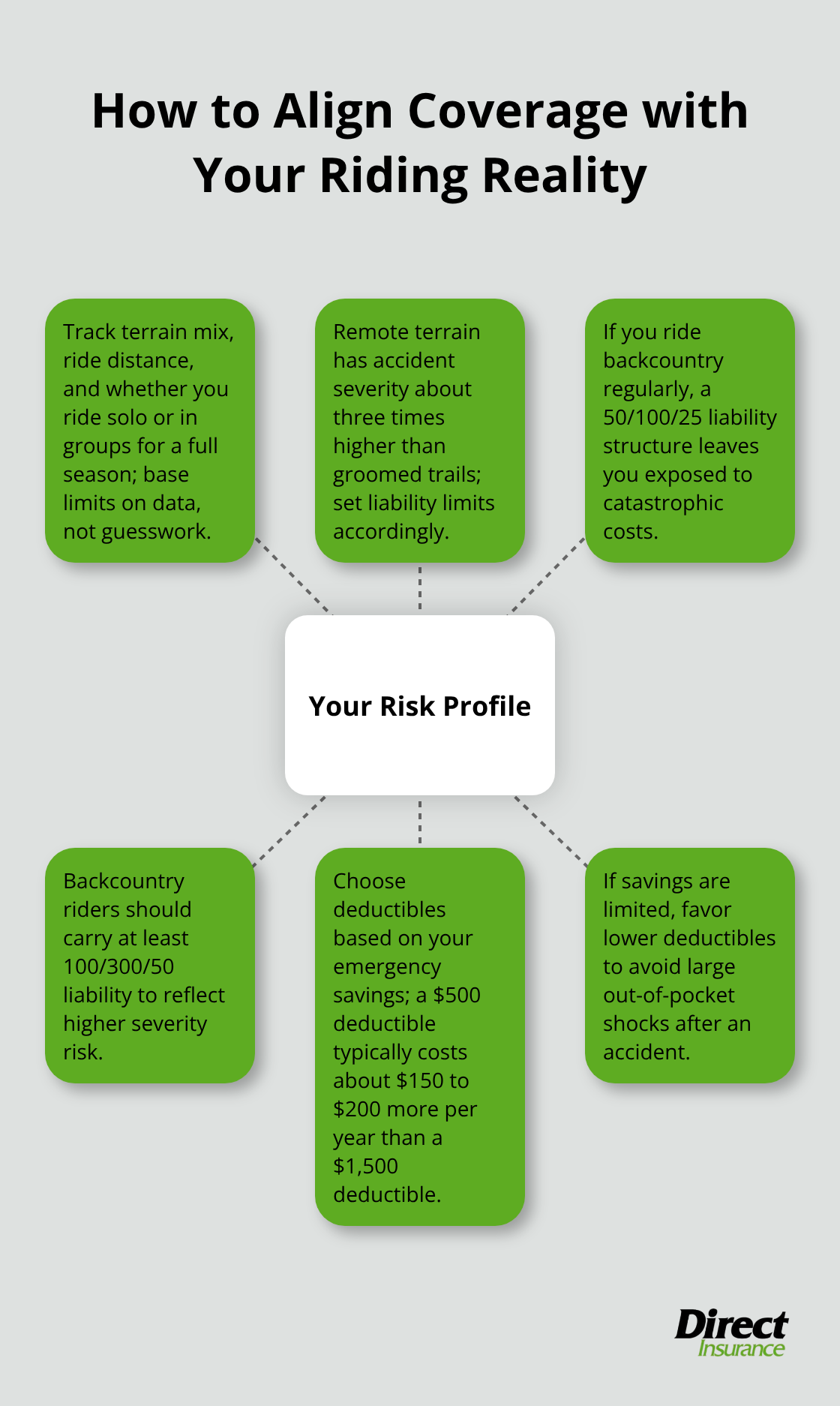
Insurance Institute for Highway Safety data shows that riders in remote terrain experience accident severity rates three times higher than groomed-trail riders, which means your liability limit should reflect that reality. If you venture into backcountry regularly, a 50/100/25 liability structure leaves you personally exposed to catastrophic costs. Backcountry riders should carry minimum liability limits of 100/300/50 because the math is unforgiving-a single serious accident in remote terrain can generate medical and rescue costs exceeding $200,000 before property damage factors in.
Choose Your Deductible Based on Your Financial Capacity
Your deductible choice directly impacts your premium and your out-of-pocket costs when accidents happen. Selecting appropriate coverage limits requires understanding your actual financial emergency fund rather than simply selecting the middle option. A $500 deductible costs roughly $150 to $200 more annually than a $1,500 deductible, yet riders with less than $3,000 in emergency savings should select the lower deductible because they cannot absorb a $1,500 surprise expense after an accident.
Conversely, riders with substantial savings waste money paying higher premiums for low deductibles they will never use. An independent local agent can run side-by-side quotes showing your exact premium differences at various deductible levels-this concrete comparison beats any general recommendation. The goal isn’t the lowest premium; it’s the lowest total cost of insurance plus potential out-of-pocket expenses based on your accident probability and financial capacity.
Match Your Deductible to Your Safety Record
A backcountry rider with spotty safety records should accept a higher premium and lower deductible, while an experienced groomed-trail rider with a clean record can reasonably select higher deductibles to reduce annual costs. Your accident history directly influences how much financial risk you can afford to carry through higher deductibles. Riders who frequently venture into remote areas should prioritize lower deductibles because their accident probability is substantially higher (the Insurance Institute data confirms this with those three-times-higher severity rates for remote terrain).
At Direct Insurance Services, we help clients model these scenarios using their actual riding patterns and financial situations rather than applying generic formulas. Your specific circumstances-not industry averages-should drive your deductible decision.
Final Thoughts
Full coverage snowmobile Utah policies protect your finances only when your limits match your actual riding exposure and financial capacity. The gap between what you assume you’re covered for and what your policy actually pays is where financial disaster happens. Utah’s backcountry terrain creates accident costs that routinely exceed $150,000 in medical expenses alone, making adequate liability limits far more than optional protection.
Pull out your current snowmobile policy and write down your actual coverage limits for liability, collision, and comprehensive protection. Compare those numbers against your riding habits-if you spend significant time in remote backcountry areas, your liability limits should be at least 100/300/50, and your collision limit should match your snowmobile’s actual cash value plus 20 percent for replacement gear. Your deductible should reflect your emergency savings capacity, not just the lowest premium option.
Contact Direct Insurance Services to review your current coverage against your actual riding exposure. We work with top-rated carriers to help you find coverage that fits both your needs and your budget, and our experienced team provides clear guidance on selecting limits that actually protect your finances rather than leaving you exposed to catastrophic costs.
Disclaimer: The information provided in this blog is for general informational purposes only and does not constitute legal, financial, or insurance advice. Coverage options, terms, and availability may vary. Please consult with a licensed professional for advice specific to your situation


